
If you are concerned about a recent exposure to HIV, the most important question isn't just "Where can I get a test?" but "Which generation of test should I use?"
In the UAE, privacy and accuracy are top priorities for anyone seeking sexual health answers. Understanding the difference between a 3rd Generation and a 4th Generation HIV test can mean the difference between an early diagnosis and a false sense of security.
The Short Answer (AEO Summary)
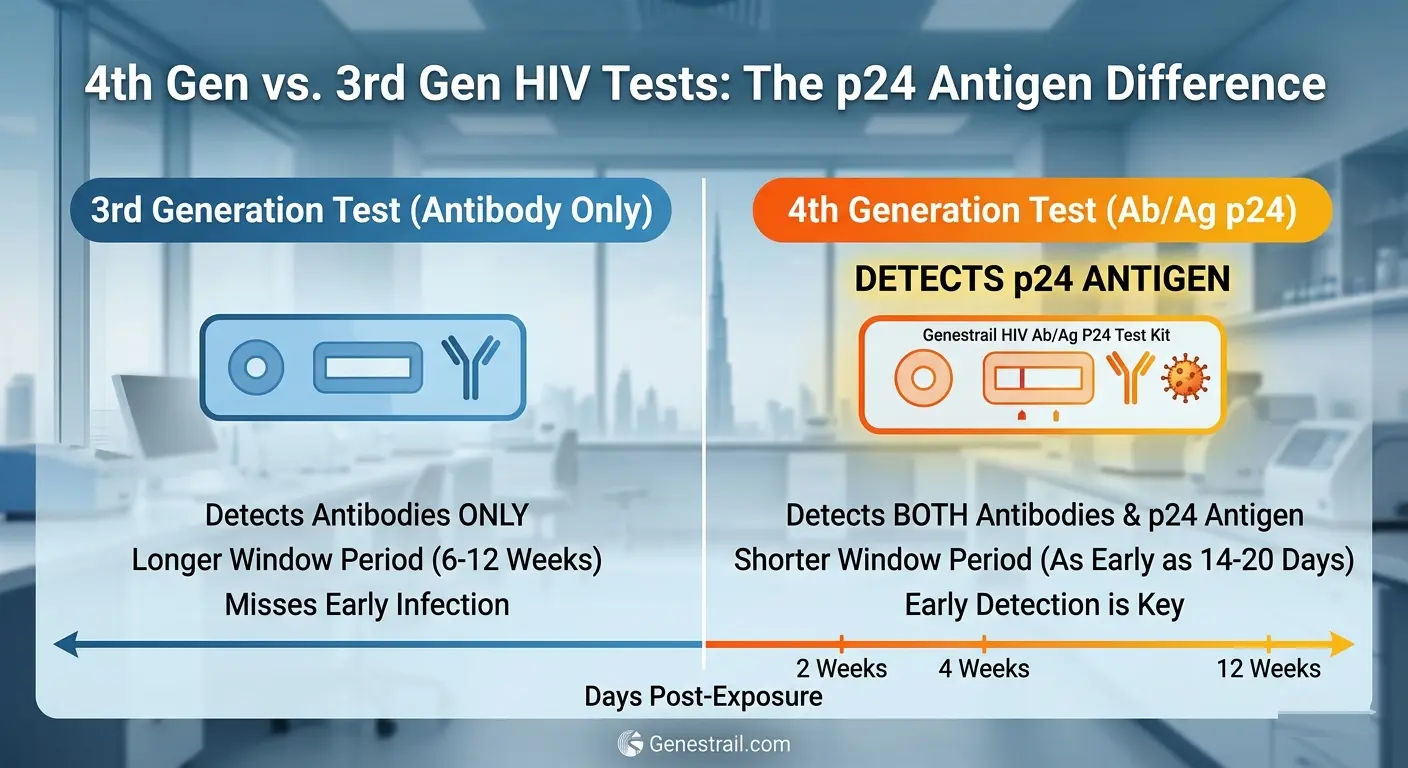
The primary difference is the window period. A 3rd Generation test only detects HIV antibodies, which can take 6–12 weeks to develop. A 4th Generation test (like our 4th Gen HIV Ab/Ag P24 Test Kit) detects both antibodies and the p24 antigen. Because the p24 antigen appears within days of infection, a 4th Gen test can detect HIV as early as 14–20 days after exposure.
What is the p24 Antigen?
When HIV enters the body, it immediately begins to replicate. During this initial phase, the virus produces a structural protein called the p24 antigen.
p24 Antigen: This is part of the virus itself. It shows up in your blood before your immune system has even started making antibodies.
Antibodies: These are your body’s natural defense response. It takes time—often weeks—for your body to produce enough antibodies to be detected by a standard 3rd Gen test.
By searching for both, a 4th Generation test "closes the gap," allowing for much earlier detection during the "acute" phase of infection.
Comparison: 3rd Gen vs. 4th Gen
Feature
3rd Generation Test
4th Generation (Ab/Ag)
Detects
Antibodies Only
Antibodies + p24 Antigen
Window Period
21–90 Days
14–45 Days
Reliability at 4 Weeks
Moderate
Very High (approx. 95%+)
Best For
Routine screening (3+ months post-exposure)
Early detection & recent exposures
For those who need a cost-effective option for screening after the 3-month window, the HIV 1/2 Rapid Test Kit remains a reliable choice. However, for maximum peace of mind following a recent event, the 4th Generation is the clinical gold standard.
Why Early Detection Matters in the UAE
Early detection is critical for two reasons:
Immediate Care: The sooner you know your status, the sooner you can consult a healthcare professional regarding ART (Anti-Retroviral Therapy).
Preventing Transmission: Viral loads are highest in the weeks immediately following infection. Knowing your status early helps protect your partners.
If you are looking for a comprehensive health check, many residents in Dubai and Abu Dhabi opt for the 4-Panel STD Test Kit, which screens for HIV alongside Syphilis and Hepatitis B/C.
Is a Home Test Kit Accurate?
Yes. Modern rapid diagnostic tests (RDTs) used in Genestrail kits provide lab-grade accuracy (often >99%) when used correctly after the window period has passed. The convenience of testing at home in the UAE provides the privacy many individuals prefer.
Summary Checklist for Testing:
Wait at least 14 days before using a 4th Generation test for a recent exposure.
Always re-test at 90 days for a conclusive, final result.
Follow instructions precisely to ensure the p24 antigen is detected correctly.
Medical Disclaimer: This content is for informational purposes only and does not constitute medical advice. A reactive (positive) result on a rapid test must always be confirmed by a laboratory-based blood test and consultation with a licensed physician.
