
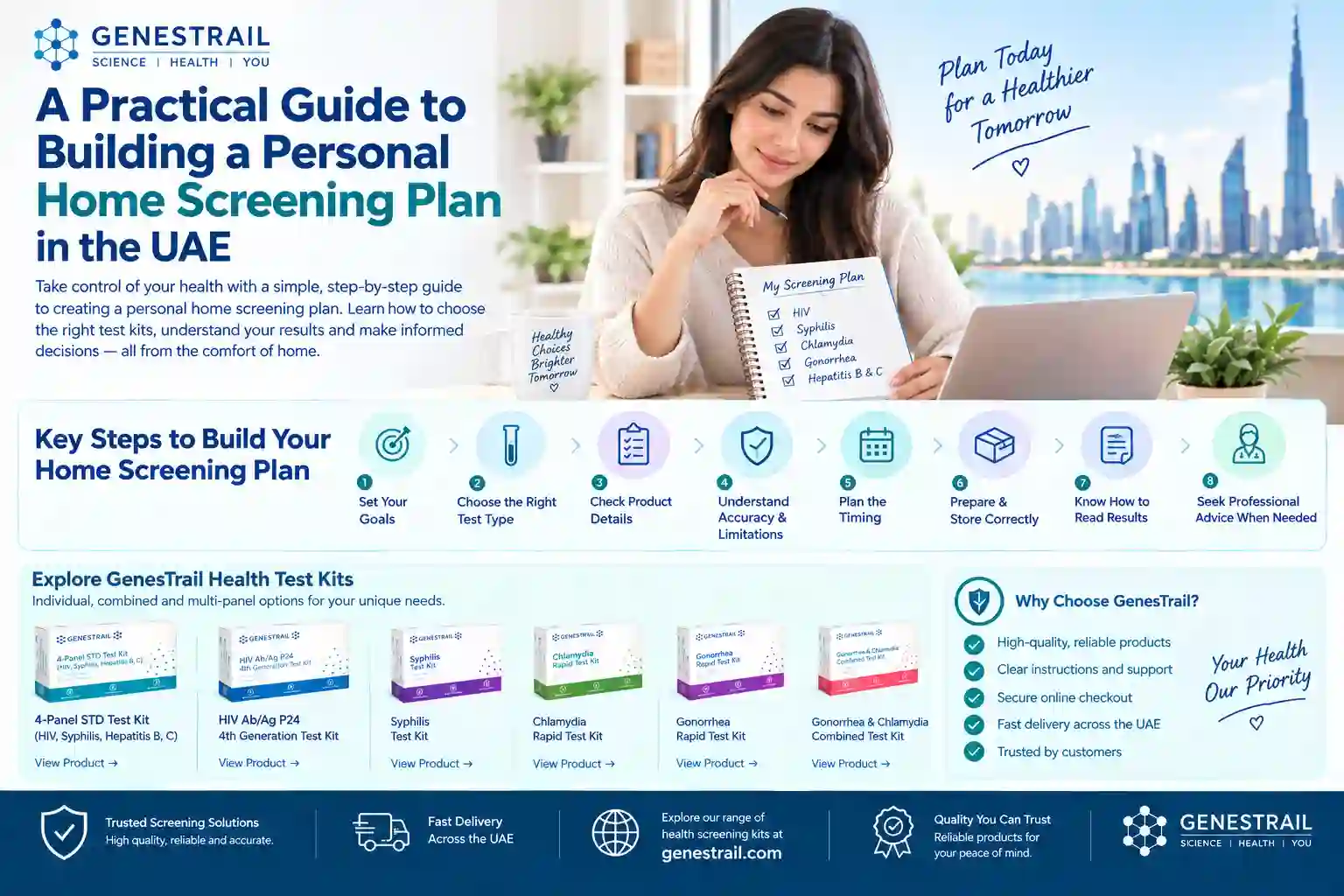
Home health screening can be a convenient way to stay informed about your health from the privacy of your own home. With different individual and multi-panel test kits available online, UAE residents can explore screening options based on their personal needs, testing goals and circumstances.
However, building a useful home screening plan is about more than purchasing several test kits. It involves understanding what you want to screen for, which type of test is appropriate, when testing may be useful, how to use the kit correctly, and when professional healthcare advice may be needed.
This guide explains how to create a practical home screening plan while making informed choices about available screening products.
What Is a Personal Home Screening Plan?
A personal home screening plan is a simple approach to organizing your health-screening needs around relevant factors such as age, health concerns, previous testing, symptoms, risk factors and healthcare recommendations.
A plan does not necessarily mean testing for everything at once.
Instead, it can help you identify:
Which screening areas are relevant to you
Which tests are individual or combined
When a particular test may be appropriate
Which products match your intended screening purpose
How to prepare before testing
How to manage and understand your results
When professional testing or medical advice may be appropriate
Home-use tests can provide useful information for certain conditions, but they should complement—not replace—appropriate healthcare. The FDA recommends regular healthcare visits and notes that many test results are best considered alongside medical history, examination and other testing.
Step 1: Start With Your Screening Goals
Before purchasing a test kit, identify what you actually want to learn.
Your goal might be:
General health awareness
Screening for a specific condition
Following a healthcare professional's recommendation
Reviewing your health after a particular concern
Choosing a broader multi-panel screening option
Starting with the goal makes it easier to avoid buying tests that are unrelated to your needs.
For example, someone specifically interested in HIV screening may want an individual HIV test, while someone looking for broader screening may consider a multi-panel option.
Step 2: Understand Individual and Combined Test Kits
The next step is deciding whether individual or combined screening is more appropriate.
Individual Test Kits
An individual kit focuses on a particular screening target.
This may be useful when:
You need one specific test
You have already completed other screening
A healthcare professional has recommended a particular test
You want a focused screening option
For example, someone looking specifically for syphilis screening may choose an individual syphilis test rather than a broader panel.
Combined Test Kits
A combined kit can include several screening targets in one product.
This can be convenient when multiple screening areas are relevant.
GenesTrail offers a 4-Panel STD Test Kit covering HIV, syphilis, hepatitis B and hepatitis C, providing a multi-target option for customers looking for broader screening.
Step 3: Identify Which Screening Areas Are Relevant
Once you know your overall goal, list the screening areas that may be relevant.
For example, your personal screening plan might include:
Individual screening
HIV
Syphilis
Chlamydia
Gonorrhea
Combined screening
HIV
Syphilis
Hepatitis B
Hepatitis C
Chlamydia and gonorrhea together
The exact tests appropriate for an individual can vary. CDC guidance notes that STI testing recommendations depend on factors such as age, location, sexual history, current practices and symptoms, and healthcare professionals can help determine which tests are appropriate.
Consider a 4-Panel Screening Option
For customers interested in broader screening, the GenesTrail 4-Panel STD Test Kit can be included in the comparison stage of a personal screening plan.
GenesTrail 4-Panel STD Test Kit
This product is designed around four listed screening targets: HIV, syphilis, hepatitis B and hepatitis C. Always review the product information and instructions before purchasing or using any test.
Step 4: Consider Whether an Individual HIV Test Fits Your Goal
If your screening plan is focused specifically on HIV, an individual product may be more relevant than a broader panel.
GenesTrail provides an HIV Ab/Ag P24 4th Generation Test Kit for customers looking for an HIV-specific screening option.
GenesTrail HIV Ab/Ag P24 4th Generation Test Kit
When considering any HIV test, pay attention to the specific test type, intended use and timing information. HIV tests have different detection windows, so a test taken too soon after a possible exposure may not provide the information you expect.
CDC guidance recommends following the instructions supplied with an HIV self-test and discussing testing and follow-up with healthcare professionals when appropriate.
Step 5: Add Individual Tests Only When They Match Your Plan
A good screening plan should be focused rather than unnecessarily complicated.
If your intended screening goal includes syphilis, for example, an individual syphilis test may be considered.
GenesTrail offers:
Similarly, customers looking for individual chlamydia or gonorrhea screening can explore separate options.
GenesTrail Chlamydia Rapid Test Kit
GenesTrail Gonorrhea Rapid Test Kit
The important point is to select products based on your intended screening purpose rather than simply choosing the largest number of tests.
Step 6: Consider Combined Chlamydia and Gonorrhea Screening
If both chlamydia and gonorrhea screening are relevant to your plan, a combined product may be worth considering.
GenesTrail provides a:
Gonorrhea & Chlamydia Combined Rapid Test Kit
A combined option may simplify product selection when both listed targets are part of the intended screening plan.
Always review the product's specific instructions, sample requirements and intended use before testing.
Step 7: Check the Test Instructions Before You Buy
A home screening plan should include an instruction-checking step before you place an order.
Review:
What the test is designed to detect
Sample type
Collection procedure
Required materials
Testing steps
Timing requirements
Storage conditions
Expiration information
Result interpretation
Test limitations
The FDA specifically recommends reading home-use test instructions carefully and checking storage, sample collection, timing, expiration and interpretation requirements before testing.
Step 8: Build Testing Around Appropriate Timing
Timing is one of the most important parts of a home screening plan.
Testing too early may mean that a condition has not yet become detectable by the particular test.
The appropriate timing depends on:
The condition being tested
The test technology
The sample being used
The manufacturer's instructions
The circumstances that led you to consider testing
For some health concerns, a healthcare professional may recommend repeat or laboratory testing.
Do not create a testing schedule based only on a generic internet timetable. Use the instructions for the specific test and seek professional advice when timing is uncertain.
Step 9: Create a Simple Testing Record
Keeping a basic testing record can make your screening plan easier to manage.
You can record:
InformationWhat to Record
Test date
Date the test was performed
Product
Name of the test kit
Test target
What the test screens for
Result
Negative, reactive or invalid, as applicable
Testing conditions
Any relevant notes
Follow-up
Whether further testing or professional advice is needed
Keeping records can also help you avoid repeating a test unnecessarily or forgetting when a previous screening test was performed.
The FDA recommends keeping good records of home testing.
Step 10: Store Your Test Kits Correctly
Your screening plan should also include a storage routine.
When storing home test kits:
Follow the manufacturer's recommended temperature range
Keep products away from direct sunlight
Protect kits from excessive heat and moisture
Keep products in their original packaging when appropriate
Check expiration dates before use
Avoid storing products in unsuitable locations such as a hot vehicle
Storage requirements vary by product, so always follow the instructions supplied with the specific kit.
This is particularly worth considering in the UAE, where high temperatures can make proper storage especially important.
Step 11: Prepare Before Testing
When you are ready to perform a home screening test, avoid rushing.
A simple preparation checklist can include:
Read the complete instructions.
Check the expiry date.
Confirm the kit has been stored correctly.
Wash your hands if required.
Prepare a clean testing area.
Have all required components available.
Follow the specified sample-collection procedure.
Use the exact timing stated in the instructions.
Read the result only within the specified interpretation period.
The FDA advises users to follow all test instructions because incorrect timing, sample collection or other deviations can affect results.
Step 12: Understand What Your Result Means
A personal screening plan should include a plan for different possible outcomes.
Negative or Non-Reactive Result
A negative or non-reactive result may indicate that the target was not detected by that test at that time.
However, interpretation depends on the specific product and testing circumstances.
Testing too early, incorrect sample collection or other factors can affect results.
Reactive or Positive Result
A reactive or positive screening result may require additional testing or professional evaluation.
Do not automatically treat a screening result as a final diagnosis.
For some conditions, confirmatory testing is required.
Invalid Result
An invalid result generally means that the test did not produce a valid result.
Follow the manufacturer's instructions to determine whether you should repeat testing with a new kit or seek another testing method.
Step 13: Know When Home Screening Is Not Enough
Home screening can be useful, but it is not suitable for every situation.
Consider professional healthcare advice if:
You have symptoms
You are concerned about a recent possible exposure
Your result is reactive or positive
Your result is invalid repeatedly
Your result conflicts with your symptoms or circumstances
You are unsure which test you need
You are unsure when to test
The product instructions recommend professional follow-up
CDC guidance emphasizes discussing STI testing with a healthcare provider even when someone has used a self-test or self-collection option.
Step 14: Review Your Screening Plan Regularly
A personal screening plan should not remain exactly the same forever.
Your needs can change because of:
Changes in health
New symptoms
Changes in personal circumstances
Previous test results
Healthcare recommendations
Changes in screening guidelines
Review your plan periodically rather than automatically repeating every test at the same interval.
A healthcare professional can help determine whether a particular test should be repeated and how frequently it may be appropriate.
A Simple UAE Home Screening Checklist
Before starting your personal home screening plan, ask:
What am I trying to screen for?
Do I need an individual or combined test?
What sample does the product require?
Is the product appropriate for my intended purpose?
Have I checked the instructions?
Is the kit within its expiry date?
Has it been stored correctly?
Do I understand the testing procedure?
Do I know when the result should be read?
Do I know what I will do if the result is reactive?
Do I know what to do if the result is invalid?
Do I need professional advice?
This checklist can make home screening more organized and reduce avoidable mistakes.
Building a Practical Product List
Instead of purchasing multiple products immediately, create a shortlist based on your actual screening goals.
For example:
Focused screening:
Choose an individual product for a specific target.
Broader screening:
Consider a multi-panel product when several listed targets are relevant.
Two-target screening:
A combined product may be convenient when both targets are part of your plan.
GenesTrail provides a range of screening products that can be reviewed according to these categories.
You can explore the full range of available options through the GenesTrail website.
Frequently Asked Questions
What is a personal home screening plan?
It is a structured approach to deciding which home screening tests may be relevant, when to consider testing, how to prepare and what steps to take after receiving a result.
Should I use individual or combined test kits?
It depends on your screening goal. An individual test may be suitable for one specific target, while a combined kit may be convenient when several listed targets are relevant.
How often should I perform home screening?
There is no universal schedule for every test or every person. Frequency depends on the specific condition, personal circumstances, risk factors and healthcare recommendations.
Can I build my screening plan using home test kits?
Some tests are designed for home use. Always check the intended use, instructions and limitations of the particular product.
What should I do after a reactive result?
Follow the product instructions and seek appropriate professional healthcare advice. Depending on the test, additional or confirmatory testing may be recommended.
Can a negative result be incorrect?
Yes, depending on the test and circumstances. Testing timing, sample collection, storage and following instructions can all matter. A negative result should be interpreted according to the specific test's instructions and limitations.
What if I don't have symptoms?
Some infections can occur without noticeable symptoms. CDC notes that many STIs are asymptomatic and that appropriate testing depends on individual circumstances.
Can home screening replace a medical checkup?
No. Home-use tests can be useful tools, but they should not replace appropriate medical care or routine healthcare visits.
Final Thoughts
Building a personal home screening plan in the UAE does not have to be complicated.
Start with your screening goal, identify the tests that are actually relevant, compare individual and combined options, check product instructions and storage requirements, and keep a simple record of your testing.
GenesTrail offers individual and combined screening options that can be explored according to different testing needs, including HIV, syphilis, chlamydia, gonorrhea and multi-panel screening.
Most importantly, use home screening as part of a broader approach to health awareness. If you have symptoms, receive a concerning result, are uncertain about testing timing or need help interpreting a result, appropriate professional healthcare advice can help determine the next step.
Medical Disclaimer: This article is provided for general educational purposes and is not a substitute for professional medical advice, diagnosis or treatment. Always follow the instructions provided with the specific test kit and consult a qualified healthcare professional when you have questions or concerns about your health or test results.