
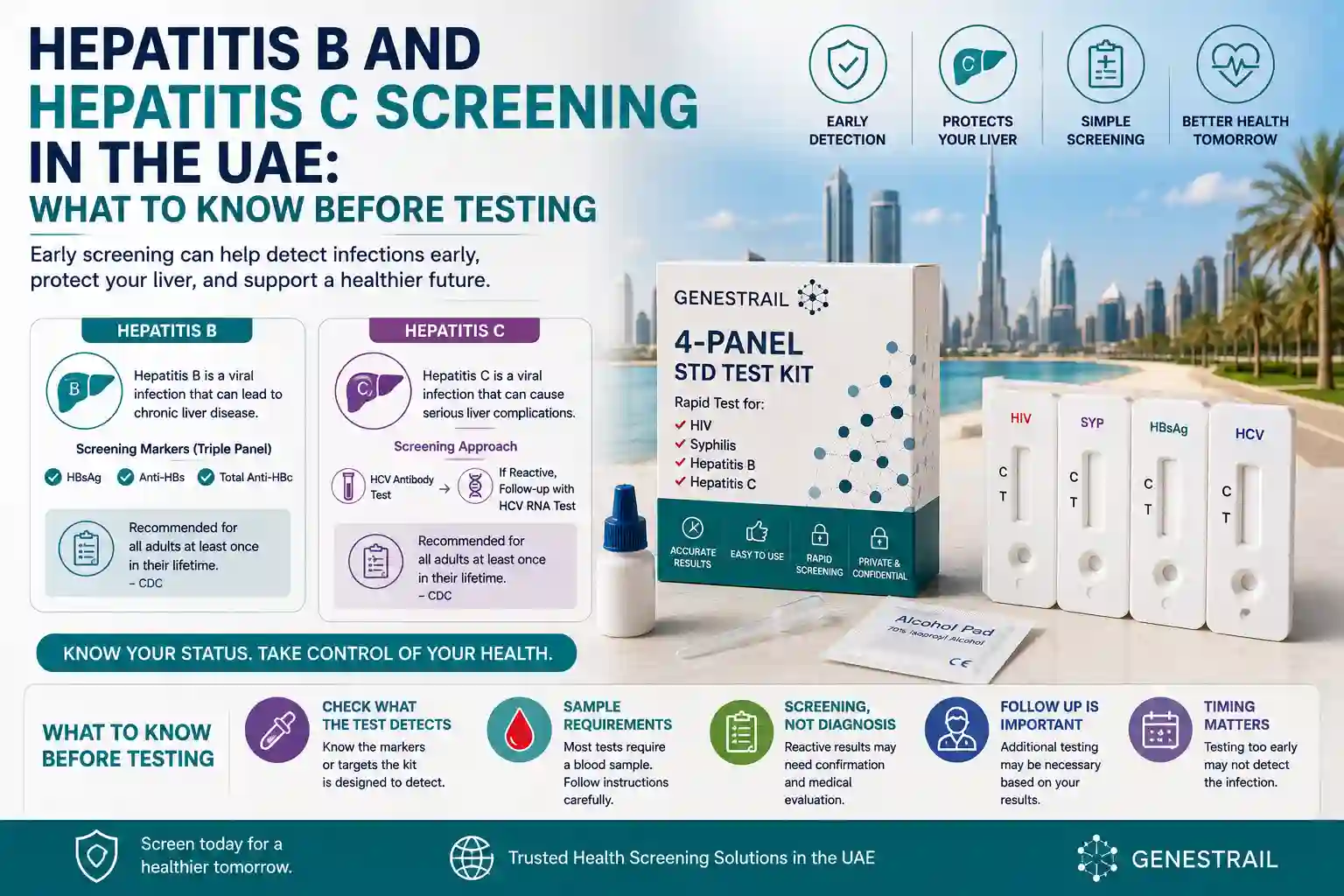
Hepatitis B and hepatitis C are viral infections that can affect the liver, and many people may not experience noticeable symptoms for a long time. This is one reason why appropriate screening can be an important part of personal health awareness.
For UAE residents researching hepatitis B and hepatitis C screening, understanding the differences between these two infections, available testing approaches, sample requirements, and possible follow-up steps can help you make better-informed decisions.
This guide explains what to know before testing and how to compare screening options, including multi-panel products available through GenesTrail.
Important: Screening tests are not always the same as diagnostic testing. A reactive or positive screening result may require additional laboratory testing and professional medical evaluation.
What Are Hepatitis B and Hepatitis C?
Hepatitis B and hepatitis C are infections caused by different viruses that can affect the liver.
Both can become chronic in some people and may contribute to serious liver complications if they remain undetected and untreated. Many people may have few or no symptoms, which is why testing can be important.
Although they are both called viral hepatitis, hepatitis B and hepatitis C are not the same infection. They also differ in their prevention, testing methods, and treatment options.
Why Consider Hepatitis Screening?
One of the main reasons screening is important is that a person may not know they have an infection.
The CDC recommends hepatitis B screening for all adults aged 18 and older at least once in their lifetime, with additional testing for people with ongoing risk. For hepatitis C, CDC recommends testing all adults at least once, with more frequent testing for certain people with ongoing risks or specific exposures.
Testing can help identify an infection earlier and create an opportunity for appropriate medical follow-up.
The World Health Organization also describes testing and diagnosis as an important gateway to prevention and treatment services for hepatitis B and C.
Hepatitis B Screening: What You Should Know
Hepatitis B screening commonly involves blood testing for specific markers associated with hepatitis B virus infection and immunity.
For initial adult screening, CDC recommends a triple-panel blood test consisting of:
HBsAg
Anti-HBs
Total anti-HBc
These markers can help healthcare professionals determine whether a person has a current infection, has immunity, or may be susceptible to infection.
Because different products can detect different markers, it is important to check exactly what a particular screening kit is designed to detect.
Hepatitis C Screening: What You Should Know
Hepatitis C screening commonly begins with an HCV antibody test.
A reactive antibody result does not by itself establish that a person currently has hepatitis C. CDC recommends follow-up testing with an HCV RNA nucleic acid test when an antibody test is reactive to determine whether current infection is present.
This distinction is important when interpreting home or rapid screening results.
A screening product should therefore be viewed as part of a testing process rather than automatically as a final diagnosis.
Hepatitis B vs. Hepatitis C: Key Differences
Although both conditions affect the liver, their testing approaches are different.
FeatureHepatitis BHepatitis C
Virus
HBV
HCV
Common screening approach
Blood tests for HBV markers
HCV antibody testing followed by RNA testing when reactive
Multiple markers may be used
Yes
Antibody and, when indicated, RNA
Can become chronic?
Yes
Yes
Follow-up may be required?
Yes
Yes
Vaccine available?
Yes
No vaccine is currently available
For hepatitis B, the CDC's recommended adult screening approach uses three serologic markers. For hepatitis C, antibody screening is followed by HCV RNA testing when the antibody result is reactive.
Can One Screening Kit Cover Both Hepatitis B and Hepatitis C?
Some multi-panel screening products are designed to include both hepatitis B and hepatitis C alongside other screening targets.
For example, the GenesTrail 4-Panel STD Test Kit is listed as covering:
HIV
Syphilis
Hepatitis B
Hepatitis C
View the GenesTrail 4-Panel STD Test Kit
A multi-panel option may be convenient for people who are looking for broader screening through one product. However, always review the product's specific intended use, methodology, sample requirements, and limitations before testing.
What Should You Check Before Buying a Hepatitis Test Kit?
If you are searching for a hepatitis test kit in the UAE, avoid choosing a product based only on its name or price.
Consider the following factors.
1. What Does the Test Detect?
First, check the exact marker or target the product is designed to detect.
For hepatitis B, different tests may identify different serologic markers. For hepatitis C, an antibody test and an HCV RNA test serve different purposes.
Understanding what the product detects helps you avoid assuming that every "hepatitis test" provides the same information.
2. What Sample Is Required?
Check the product information to determine the required specimen.
Many hepatitis screening approaches use blood samples, but the exact collection method depends on the product.
Before purchasing, check:
Sample type
Collection method
Included collection materials
Sample handling requirements
Testing procedure
3. Is It a Screening Test or Diagnostic Test?
This is an important distinction.
A screening test can identify a marker that may require further evaluation. A reactive result may need additional testing to determine whether an infection is currently present.
For hepatitis C, for example, a reactive antibody test is followed by HCV RNA testing to identify current infection.
4. Check the Intended Use
Read the product description carefully.
Confirm whether the product is designed for home screening, rapid screening, professional use, or another specific purpose.
Do not assume that a product intended for one setting can be used in another way.
5. Check the Expiry Date and Packaging
Before using a test kit:
Check the expiry date.
Inspect the packaging.
Make sure the components are intact.
Follow the recommended storage conditions.
If the packaging appears damaged or the product is expired, follow the manufacturer's guidance.
How to Prepare for Hepatitis Screening
Preparation depends on the specific product.
Before beginning a home or rapid screening procedure, read the manufacturer's instructions completely.
A basic preparation checklist includes:
Check the product expiry date.
Inspect the packaging.
Prepare a clean testing area.
Read the sample collection instructions.
Make sure all required components are available.
Follow the specified procedure.
Observe the recommended result-reading time.
Do not use instructions from another product as a substitute for the manufacturer's instructions.
Does Testing Timing Matter?
Testing timing can be important, particularly when testing follows a recent potential exposure.
Different tests detect different markers, and those markers may not become detectable immediately.
If you believe you may have been recently exposed to hepatitis B or C, ask a qualified healthcare professional which test is appropriate and when it should be performed.
For hepatitis C, CDC specifically notes that people who may have been exposed within the previous six months may require HCV RNA testing rather than relying only on an antibody test.
Understanding a Hepatitis B Screening Result
Hepatitis B results can involve several different markers, which is why professional interpretation can be useful.
Depending on the combination of markers, testing may help determine whether someone:
Has a current infection
Has previously had an infection
Is immune because of vaccination
Is immune following previous infection
Is susceptible to infection
CDC recommends using the HBV triple panel for initial adult screening because the combination provides more information than relying on a single marker alone.
If you receive an abnormal or reactive result from a screening product, professional evaluation may be necessary to understand what it means.
Understanding a Hepatitis C Screening Result
Hepatitis C screening requires particular attention to the distinction between antibodies and current infection.
Non-Reactive Antibody Result
A non-reactive antibody result generally means that HCV antibodies were not detected.
However, if a person may have been exposed recently, additional testing may be recommended because antibodies may not yet be detectable.
Reactive Antibody Result
A reactive HCV antibody result means antibodies were detected, but it does not necessarily mean that the person currently has hepatitis C.
CDC recommends follow-up HCV RNA testing after a reactive antibody result to determine whether current infection is present.
This is why a reactive screening result should not automatically be interpreted as a final diagnosis.
What If a Screening Result Is Positive or Reactive?
Do not panic, but do not ignore the result either.
The appropriate next step depends on the specific test and result.
If a screening result is reactive:
Review the manufacturer's instructions.
Check whether confirmatory or follow-up testing is recommended.
Contact a qualified healthcare professional.
Complete any recommended follow-up testing.
For hepatitis C, a reactive antibody result specifically requires follow-up testing to determine whether current infection is present.
What If the Result Is Invalid?
An invalid result generally means the test did not produce an interpretable result according to the product's instructions.
Do not treat an invalid result as either positive or negative.
Instead:
Review the manufacturer's instructions.
Check whether the procedure was followed correctly.
Follow the recommended process for repeat testing.
Seek professional advice if you remain uncertain.
Home Screening vs. Professional Testing
Home or rapid screening can offer convenience, but professional testing has an important role in diagnosis and follow-up.
Home or Rapid Screening May Offer:
Convenience
Privacy
Flexible scheduling
An accessible initial screening option
Professional Testing Can Provide:
Clinical assessment
More comprehensive testing
Interpretation of multiple laboratory markers
Confirmatory testing
Medical follow-up
For hepatitis B and C, the type of testing needed can depend on previous results, exposure history, symptoms, vaccination status, and other circumstances.
Why a Multi-Panel Kit May Be Convenient
A multi-panel screening kit can be useful when several screening areas are relevant.
Rather than selecting separate products for each target, a combined kit can bring multiple specified screening areas together.
The GenesTrail 4-Panel STD Test Kit includes hepatitis B and hepatitis C alongside HIV and syphilis:
GenesTrail 4-Panel STD Test Kit
However, a multi-panel kit should not automatically be considered a replacement for comprehensive clinical testing. Buyers should verify exactly what each panel detects and understand whether follow-up testing may be required.
Who Should Consider Hepatitis Screening?
Testing recommendations vary by country, healthcare system, age, pregnancy status, medical history, and exposure risk.
CDC recommends hepatitis B screening for all adults at least once and additional testing for people with ongoing risk. It recommends hepatitis C testing for all adults at least once, with additional testing for certain groups and exposures.
Pregnancy is another situation where hepatitis screening is specifically recommended. For hepatitis B, CDC recommends HBsAg screening during each pregnancy; hepatitis C screening is also recommended during each pregnancy in applicable settings.
For UAE residents, local healthcare providers can advise on the screening schedule and testing requirements that apply to individual circumstances.
Common Mistakes to Avoid
When purchasing or using a hepatitis screening kit, avoid these common mistakes.
Choosing Based Only on Price
The cheapest product is not automatically the most appropriate.
Consider the intended use, screening targets, instructions, and follow-up requirements.
Assuming All Hepatitis Tests Are the Same
Hepatitis B and hepatitis C require different testing approaches.
Even tests for the same infection can detect different markers.
Ignoring Follow-Up Testing
Some screening results require additional testing.
For hepatitis C, a reactive antibody result needs follow-up HCV RNA testing to determine current infection.
Testing Without Reading Instructions
Always read the product-specific instructions before starting.
Treating Screening as a Diagnosis
A screening result can provide useful information, but it may not establish a final diagnosis.
Frequently Asked Questions
What is the difference between hepatitis B and hepatitis C?
They are different viral infections that can affect the liver. They also use different testing approaches and have different prevention and treatment considerations.
Can hepatitis B and C be screened together?
Some multi-panel products are designed to include both hepatitis B and hepatitis C. The GenesTrail 4-Panel STD Test Kit is one such product and also includes HIV and syphilis screening targets.
Is a hepatitis screening test the same as a diagnostic test?
Not necessarily. Some screening results require additional testing to determine whether an infection is currently present.
What does a reactive hepatitis C antibody result mean?
A reactive HCV antibody result indicates that antibodies were detected, but it does not by itself establish current infection. HCV RNA testing is recommended to determine whether the virus is currently present.
Can hepatitis screening be done at home?
Some products are designed for home or rapid screening, but the exact intended use depends on the product. Always check the manufacturer's instructions and limitations.
What should I do after a reactive result?
Follow the product instructions and consult a qualified healthcare professional. Additional testing may be necessary depending on the specific result.
Final Thoughts
Hepatitis B and hepatitis C screening in the UAE can be an important part of personal health awareness, particularly because these infections may not always cause noticeable symptoms.
Before choosing a screening product, look carefully at what it detects, the sample required, intended use, testing method, timing, storage requirements, and follow-up recommendations.
For people looking for a combined screening option, the GenesTrail 4-Panel STD Test Kit includes hepatitis B and hepatitis C alongside HIV and syphilis.
Most importantly, remember that a screening result may need professional interpretation or confirmation. If you receive a reactive, positive, invalid, or unclear result, seek appropriate healthcare guidance for the next step.