
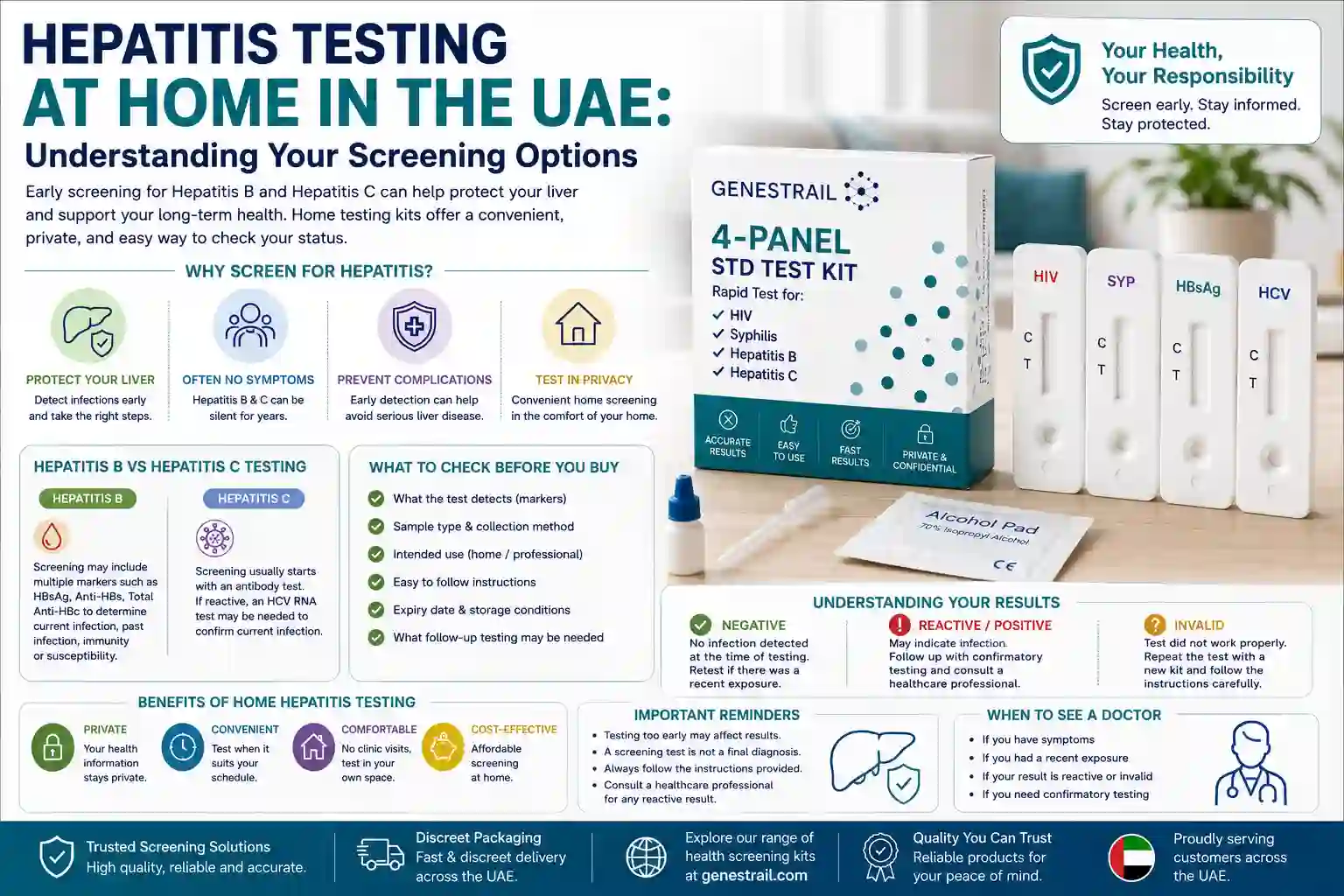
Hepatitis testing is an important part of health screening because some liver infections may not cause noticeable symptoms for a long time. For UAE residents exploring convenient screening options, home testing can be one approach to consider, depending on the specific test and its intended use.
However, not all hepatitis tests work in the same way. Hepatitis B and hepatitis C use different testing approaches, and a screening result may sometimes require additional testing or professional evaluation.
This guide explains hepatitis testing at home in the UAE, the main screening options, what to check before buying a test kit, and what to consider when interpreting results.
What Is Hepatitis?
Hepatitis refers to inflammation of the liver. Several different viruses can cause viral hepatitis, including hepatitis A, B, C, D, and E.
Hepatitis B and hepatitis C are particularly important to understand when researching blood-based screening options because both can potentially become long-term infections and affect liver health.
A person may not always experience obvious symptoms, which is one reason screening can be useful in appropriate circumstances.
Can Hepatitis Be Tested at Home?
Some screening products are designed for home or rapid use, while other hepatitis tests are performed in laboratories or healthcare facilities.
Whether home testing is appropriate depends on:
The specific infection being screened
What the test is designed to detect
The sample required
The intended use of the product
The timing of testing
Whether follow-up testing is required
Therefore, when searching for a home hepatitis test in the UAE, it is important to look beyond the product name and understand exactly what the test is designed to do.
Hepatitis B and Hepatitis C Testing Are Different
One of the most important things to understand is that hepatitis B and hepatitis C are different infections and do not use exactly the same testing process.
Hepatitis B Screening
Hepatitis B screening can involve several blood markers.
Healthcare professionals may use markers such as:
HBsAg
Anti-HBs
Total anti-HBc
These markers can provide different information about current infection, previous infection, immunity, or susceptibility.
A single screening marker does not necessarily provide the same information as a complete hepatitis B evaluation.
Hepatitis C Screening
Hepatitis C screening commonly begins with an HCV antibody test.
If antibodies are detected, additional testing may be needed to determine whether there is a current infection. HCV RNA testing can be used for this purpose.
This distinction is important when considering a hepatitis C test kit in the UAE.
A screening test and a diagnostic evaluation are not necessarily the same thing.
Why Consider Hepatitis Screening at Home?
For some people, home screening can provide practical advantages.
Convenience
Home testing may allow you to complete certain screening procedures in a familiar environment, depending on the product's intended use.
Privacy
Some people prefer a private setting when managing personal health screening.
Flexible Scheduling
A home screening product may allow greater flexibility around when you perform the test, provided that the manufacturer's instructions and testing requirements are followed.
Broader Screening Options
Some multi-panel products combine several screening targets into one kit.
This may be useful for people who are interested in broader screening rather than testing for only one target.
GenesTrail 4-Panel Screening Option
For customers in the UAE looking for a combined screening option, GenesTrail offers a 4-Panel STD Test Kit.
The product is designed to cover four specified screening areas:
HIV
Syphilis
Hepatitis B
Hepatitis C
You can review the product details here:
GenesTrail 4-Panel STD Test Kit
Before purchasing, review the product information, intended use, sample requirements, testing procedure, and limitations.
How to Choose a Home Hepatitis Test Kit in the UAE
If you are comparing hepatitis test kits in the UAE, several factors should be considered.
1. Identify the Screening Target
First, determine whether you are looking for hepatitis B screening, hepatitis C screening, or a broader multi-panel option.
Do not assume that a test labelled simply as a "hepatitis test" covers every type of viral hepatitis.
2. Check What the Test Detects
Different tests detect different markers.
For hepatitis B, several serological markers can be used.
For hepatitis C, an antibody screening test serves a different purpose from an HCV RNA test.
Always check the product description to understand the specific marker being tested.
3. Check the Sample Type
Review the product instructions to determine what type of sample is required.
Depending on the product, this may involve a specific blood specimen or another sample type.
Before buying, check:
Required sample
Collection procedure
Included collection materials
Sample handling
Testing procedure
4. Check the Intended Use
Not every hepatitis testing product is designed for home use.
Look for clear information about whether the product is intended for:
Home screening
Rapid screening
Professional use
Laboratory testing
Use the product only according to its stated intended use.
5. Review the Instructions
Read the instructions before beginning the test.
Pay attention to:
Sample collection
Test preparation
Application procedure
Testing time
Result-reading window
Storage
Invalid results
Product limitations
Following product-specific instructions is essential.
Does Testing Timing Matter?
Yes.
The time between a possible exposure and testing can influence whether a particular marker is detectable.
Different testing methods have different detection windows.
For example, hepatitis C antibody testing may not detect a recent infection immediately because the body needs time to produce detectable antibodies.
If you are concerned about a recent exposure, speak with a qualified healthcare professional about the appropriate testing method and timing.
How to Prepare for Home Hepatitis Screening
Preparation can help you use a screening product correctly.
Before testing:
Read the manufacturer's instructions completely.
Check the expiry date.
Inspect the packaging.
Confirm that the required components are included.
Prepare a clean testing area.
Understand the sample collection procedure.
Check the recommended result-reading time.
Avoid using general instructions from another product because testing procedures can differ.
What Should You Check on the Packaging?
Before using a home screening kit, examine the packaging carefully.
Look for:
Product name
Intended use
Expiry date
Storage information
Manufacturer information
Sample requirements
Instructions
Any applicable warnings or limitations
If the product is expired or the packaging appears damaged, follow the manufacturer's guidance before using it.
Understanding Hepatitis B Screening Results
Hepatitis B results can be more complex than a simple positive-or-negative interpretation because different markers can provide different information.
For example, testing may help healthcare professionals distinguish between:
Current infection
Previous infection
Immunity
Susceptibility
The interpretation depends on the combination of markers and the individual's circumstances.
If a screening product gives a reactive or concerning result, professional evaluation can help determine what the result means.
Understanding Hepatitis C Screening Results
Hepatitis C screening also requires careful interpretation.
Non-Reactive Antibody Result
A non-reactive antibody result generally means that HCV antibodies were not detected by the test.
However, if testing occurs soon after a possible exposure, antibodies may not yet be detectable.
Reactive Antibody Result
A reactive HCV antibody result means that antibodies have been detected.
It does not necessarily mean that a person currently has hepatitis C.
Additional HCV RNA testing can determine whether there is a current infection.
This is why follow-up testing can be important after a reactive screening result.
What Does an Invalid Result Mean?
Sometimes a screening test does not produce a valid result.
An invalid result should not be interpreted as positive or negative.
If this happens:
Review the manufacturer's instructions.
Check whether the procedure was followed correctly.
Follow the instructions regarding repeat testing.
Contact the appropriate product support or healthcare professional if necessary.
What If a Home Screening Result Is Reactive?
A reactive screening result should be followed up appropriately.
Do not rely on the screening result alone to make a medical diagnosis.
Instead:
Review the manufacturer's instructions.
Check whether follow-up testing is recommended.
Contact a qualified healthcare professional.
Complete any recommended confirmatory or additional testing.
For hepatitis C, a reactive antibody result generally requires HCV RNA testing to determine whether current infection is present.
Home Screening vs. Laboratory Testing
Home screening and laboratory testing can serve different purposes.
Home Screening
Depending on the product, home screening may offer:
Convenience
Privacy
Flexible scheduling
A simple screening process
Laboratory Testing
Professional laboratory testing can provide:
Broader testing options
Clinical assessment
More detailed interpretation
Additional confirmatory testing
Professional follow-up
If you need a definitive diagnosis or have a concerning result, professional healthcare services may be appropriate.
When Should You Consider Professional Testing?
Consider speaking with a healthcare professional if:
You have symptoms that concern you.
You believe you may have had a recent exposure.
A screening result is reactive.
A result is invalid or unclear.
You need confirmation of a screening result.
You are unsure which test is appropriate.
You are uncertain about testing timing.
Professional guidance can help determine which testing approach is appropriate for your circumstances.
Multi-Panel vs. Individual Hepatitis Screening
When searching for hepatitis screening in the UAE, you may encounter individual and multi-panel products.
Individual Screening
An individual test focuses on a particular screening target.
This may be appropriate when you are specifically interested in one particular area.
Multi-Panel Screening
A multi-panel product combines multiple specified screening targets.
For example, the GenesTrail 4-Panel Test Kit includes hepatitis B and hepatitis C along with HIV and syphilis.
A combined option can be convenient when broader screening is relevant.
However, always confirm the exact screening targets before purchasing.
Common Mistakes When Buying a Hepatitis Test Kit
Mistake 1: Choosing Only Based on Price
Price should not be the only factor.
Consider intended use, testing method, sample requirements, instructions, and product information.
Mistake 2: Assuming All Hepatitis Tests Are Identical
Hepatitis B and hepatitis C use different testing approaches.
Always check exactly what a product detects.
Mistake 3: Ignoring the Testing Window
Testing too early may affect the usefulness of a result.
Consider the timing of testing and seek professional advice when necessary.
Mistake 4: Skipping the Instructions
Never assume that every screening product follows the same procedure.
Read the instructions supplied with your specific product.
Mistake 5: Treating Screening as a Final Diagnosis
A screening result may indicate the need for additional testing.
Professional evaluation may be necessary to establish a diagnosis.
Frequently Asked Questions
Can hepatitis testing be done at home in the UAE?
Some products are designed for home or rapid screening. The appropriate option depends on the specific product, its intended use, and the type of hepatitis being screened.
What is the difference between hepatitis B and hepatitis C testing?
Hepatitis B screening can involve several markers, while hepatitis C screening commonly begins with an antibody test and may require HCV RNA testing if antibodies are detected.
Can one kit screen for hepatitis B and hepatitis C?
Some multi-panel products are designed to include both. The GenesTrail 4-Panel STD Test Kit includes hepatitis B and hepatitis C alongside HIV and syphilis.
Does a reactive hepatitis C antibody result mean current infection?
Not necessarily. A reactive antibody result indicates that antibodies were detected. Additional HCV RNA testing is used to determine whether there is a current infection.
What should I do if my home screening result is reactive?
Follow the product instructions and consult a qualified healthcare professional. Additional testing or professional evaluation may be recommended.
How should I choose a hepatitis test kit in the UAE?
Consider what the test detects, sample requirements, intended use, testing method, instructions, storage conditions, expiry date, and possible follow-up requirements.
Final Thoughts
Hepatitis testing at home in the UAE can be a convenient screening option when an appropriate home-use product is selected and used according to its instructions.
Before purchasing a test kit, check what it detects, the sample required, intended use, testing method, testing timing, storage requirements, and result interpretation.
For people interested in broader screening, the GenesTrail 4-Panel STD Test Kit includes hepatitis B and hepatitis C alongside HIV and syphilis.
Remember that screening is not always the same as diagnosis. A reactive, positive, invalid, or unclear result may require professional follow-up. When in doubt, consult a qualified healthcare professional for appropriate testing and next steps.