
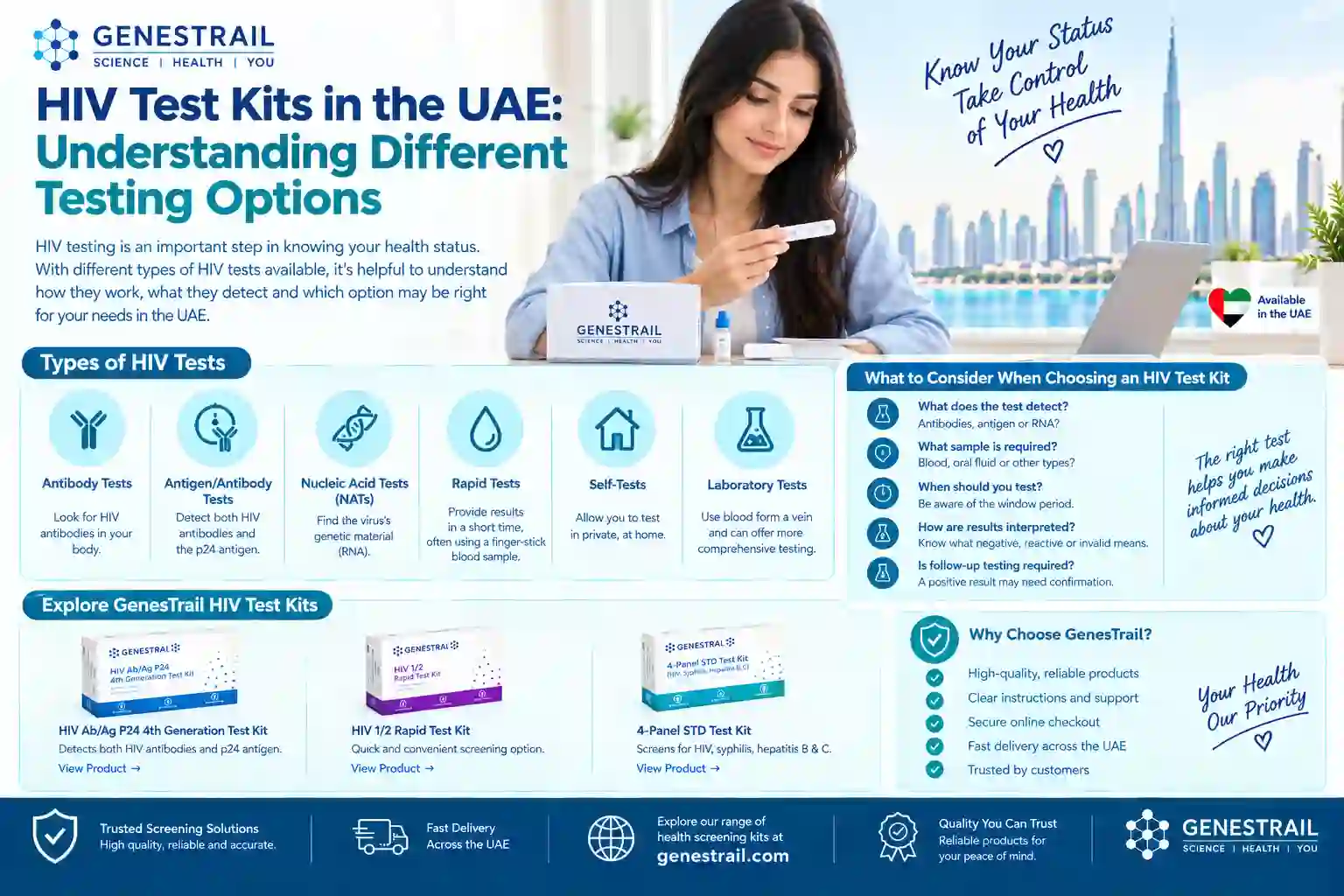
HIV testing is an important part of understanding your health status. With different types of HIV tests available today, people in the UAE may come across terms such as antibody tests, antigen/antibody tests, rapid tests, self-tests, and laboratory tests.
Understanding how these testing options differ can help you choose a test that matches your screening needs and understand why testing at the appropriate time matters.
This guide explains the main types of HIV tests, how they work, what to consider when choosing an HIV test kit in the UAE, and what different results may mean.
What Is an HIV Test?
An HIV test looks for evidence of HIV infection. Depending on the test, it may detect HIV antibodies, the p24 antigen, or the virus's genetic material.
The three main categories of HIV tests are:
Antibody tests
Antigen/antibody tests
Nucleic acid tests (NATs)
These tests do not all detect HIV at the same stage after exposure. Therefore, choosing the appropriate test and understanding its window period are important parts of HIV screening.
1. HIV Antibody Test Kits
Antibody tests look for antibodies produced by the immune system in response to HIV.
Many rapid HIV tests and self-tests use antibody detection. Depending on the product, the sample may be collected from blood or oral fluid.
Antibody tests can be useful when someone wants a convenient screening option, but the timing of testing is important because antibodies take time to become detectable.
According to the CDC, antibody tests can usually detect HIV approximately 23 to 90 days after exposure. The exact timing depends on the specific test and other factors.
2. HIV Antigen/Antibody Test Kits
Antigen/antibody tests are designed to detect both HIV antibodies and the p24 antigen.
The p24 antigen can become detectable before antibodies develop, which can allow some antigen/antibody tests to identify infection earlier than antibody-only tests.
Laboratory antigen/antibody tests using blood from a vein generally have a shorter window period than rapid finger-stick antigen/antibody tests.
For people specifically researching this type of screening in the UAE, a HIV Ab/Ag P24 4th Generation Test Kit is one product category to consider.
A 4th-generation test is called that because it combines detection of HIV antigen and antibodies rather than looking only for antibodies.
3. Rapid HIV Test Kits
Rapid tests are designed to provide results relatively quickly compared with laboratory testing.
Depending on the test, rapid HIV testing may use a finger-stick blood sample or another approved specimen type. Some rapid tests can provide results within minutes.
However, speed does not remove the importance of following the test instructions and considering the window period.
A rapid result should always be interpreted according to the manufacturer's instructions.
4. HIV Self-Test Kits
HIV self-tests allow an individual to collect and test their own sample in a private setting.
Self-testing can be convenient for people who prefer to test at home. However, users need to carefully follow the instructions provided with the specific product.
If a self-test is invalid, the result should not be interpreted as positive or negative. The test should be repeated according to the manufacturer's instructions or testing should be obtained through a healthcare provider.
A reactive or positive HIV self-test generally requires follow-up testing by a healthcare professional to establish the final result.
5. Laboratory HIV Testing
Laboratory testing is another important option, particularly when more comprehensive clinical evaluation is needed.
Laboratory antigen/antibody tests commonly use blood drawn from a vein. NATs detect HIV RNA and can generally detect infection earlier than antibody or antigen/antibody tests.
According to the CDC, a NAT can usually detect HIV around 10 to 33 days after exposure, while a laboratory antigen/antibody test can usually detect HIV around 18 to 45 days after exposure. These are general ranges, not guarantees for every individual or test.
Understanding the HIV Test Window Period
One of the most important things to understand before taking an HIV test is the window period.
The window period is the time between potential exposure to HIV and the point when a particular test can reliably detect evidence of infection.
Different HIV tests have different window periods.
HIV Test TypeTypical Detection Window*
NAT
About 10–33 days
Laboratory antigen/antibody test
About 18–45 days
Rapid antigen/antibody test
About 18–90 days
Antibody test
About 23–90 days
*These ranges are general CDC estimates and can vary by test and individual circumstances.
This is why a negative result soon after a potential exposure may not completely rule out HIV. If testing occurs during the relevant window period, repeat testing may be recommended.
How to Choose an HIV Test Kit in the UAE
When comparing HIV test kits, don't focus only on the word "rapid" or the number of minutes required to obtain a result.
Instead, consider the following:
1. What Does the Test Detect?
Check whether the test detects:
HIV antibodies
HIV antigen and antibodies
HIV RNA through a NAT
Understanding the detection method helps you understand the appropriate use and timing of the test.
2. What Sample Does It Require?
HIV tests may use different specimen types, including:
Finger-stick blood
Blood collected from a vein
Oral fluid
Always check the specific product instructions before purchasing or using a test.
3. When Should You Test?
Consider when the potential exposure occurred and the window period associated with the test.
Testing too early can produce a negative result even when infection is present.
4. How Is the Result Interpreted?
Before using a test, make sure you understand what negative, reactive/positive, and invalid results mean.
The manufacturer's instructions should always take priority for the specific product.
5. Is Follow-Up Testing Required?
A reactive or positive screening result should not simply be treated as a final diagnosis when the test requires confirmation.
Follow-up testing through a healthcare professional may be necessary.
HIV Testing Options Available Through GenesTrail
For people in the UAE researching HIV screening products, GenesTrail offers different health-testing options.
An HIV Ab/Ag P24 4th Generation Test Kit may be relevant for people specifically looking for an antigen/antibody screening option.
GenesTrail also provides an HIV 1/2 Rapid Test Kit, which can be considered by customers looking for a rapid HIV screening product according to its intended use and instructions.
For people interested in broader screening rather than HIV alone, a 4-Panel STD Test Kit combines screening for HIV, syphilis, hepatitis B, and hepatitis C in one product category.
Choosing between an individual HIV test and a multi-panel option depends on what you want to screen for and the intended use of the specific product.
Individual HIV Test vs. Multi-Panel Screening
An individual HIV test may make sense when HIV is the specific condition you want to screen for.
A multi-panel test may be useful when you want to consider several infections together.
For example:
Individual screening:
HIV-specific test kit
Broader screening:
4-panel screening for HIV, syphilis, hepatitis B, and hepatitis C
There is no need to choose a larger panel simply because it contains more tests. The appropriate option depends on your screening purpose and individual circumstances.
What Does a Negative HIV Test Result Mean?
A negative result means the test did not detect HIV according to its detection method and the test's interpretation criteria.
However, a negative result does not necessarily exclude HIV if testing occurred during the window period.
If you recently had a potential exposure, consider the specific test's window period and discuss repeat testing with a healthcare professional when appropriate.
What Does a Positive or Reactive Result Mean?
A reactive or positive screening result needs to be interpreted according to the specific test.
For HIV antibody self-tests, a positive result requires follow-up testing to confirm the result. This is an important distinction between screening and confirmation.
Do not make medical decisions based solely on an initial home screening result. Seek appropriate professional follow-up.
What Does an Invalid Result Mean?
An invalid result generally means that the test did not work properly or that the result cannot be interpreted.
An invalid result is not the same as a negative result.
Follow the manufacturer's instructions about repeating the test or obtaining testing from a healthcare provider.
Tips for Using an HIV Test Kit at Home
If you are using a home HIV test, follow these basic steps:
Read all instructions before starting.
Check the expiry date.
Check whether the kit has been stored according to its instructions.
Prepare the required sample carefully.
Follow the specified timing exactly.
Interpret the result only within the instructed time period.
Do not interpret an invalid result as negative.
Seek professional follow-up for a reactive or positive result.
Consider the window period when interpreting a negative result.
FDA guidance for home-use tests emphasizes correct sample collection, storage, timing, expiration checks, and following the manufacturer's instructions.
When Should You Consider HIV Testing?
People may consider HIV testing for different reasons, including routine sexual-health screening, a new relationship, concerns about a potential exposure, or healthcare recommendations.
The appropriate timing depends on the circumstances and the type of HIV test being used.
If you believe you have recently been exposed to HIV, do not rely only on the result of an immediately performed test. Speak with a healthcare professional about appropriate testing and timing.
Frequently Asked Questions
Which HIV test is most commonly used?
HIV testing includes antibody tests, antigen/antibody tests, and NATs. The appropriate test depends on the testing situation, timing, and clinical circumstances.
What is a 4th-generation HIV test?
A 4th-generation HIV test is an antigen/antibody test that detects both HIV antibodies and the p24 antigen.
Can I test for HIV at home?
Some HIV self-tests are designed for home or private-location use. The exact availability and regulatory status of products can vary by country, so check the product information and applicable local requirements.
Can a negative HIV test be wrong?
A negative result can occur during the window period before a test can detect an infection. Testing accuracy also depends on using the test correctly.
Does a positive HIV self-test mean I definitely have HIV?
A reactive or positive self-test generally requires follow-up testing to confirm the result.
Can HIV testing be combined with other screening?
Yes, some multi-panel screening products are designed to test for HIV alongside other conditions. The choice depends on the individual's screening needs and the specific product.
Final Thoughts
Understanding the different HIV testing options can make it easier to choose an appropriate screening approach.
Antibody tests, antigen/antibody tests, rapid tests, self-tests, and laboratory tests all have different characteristics. The most important considerations include what the test detects, the sample required, the window period, how results are interpreted, and whether follow-up testing is required.
For UAE residents considering home screening, always choose a product according to its intended use, follow the manufacturer's instructions carefully, and remember that an initial screening result may require professional follow-up.
GenesTrail provides HIV and other health screening test-kit options for customers in the UAE, including individual and multi-panel screening products.
Medical Disclaimer: This article is for general educational purposes and does not replace professional medical advice, diagnosis, or treatment. If you have concerns about a recent HIV exposure, symptoms, or a reactive/positive screening result, consult a qualified healthcare professional.