
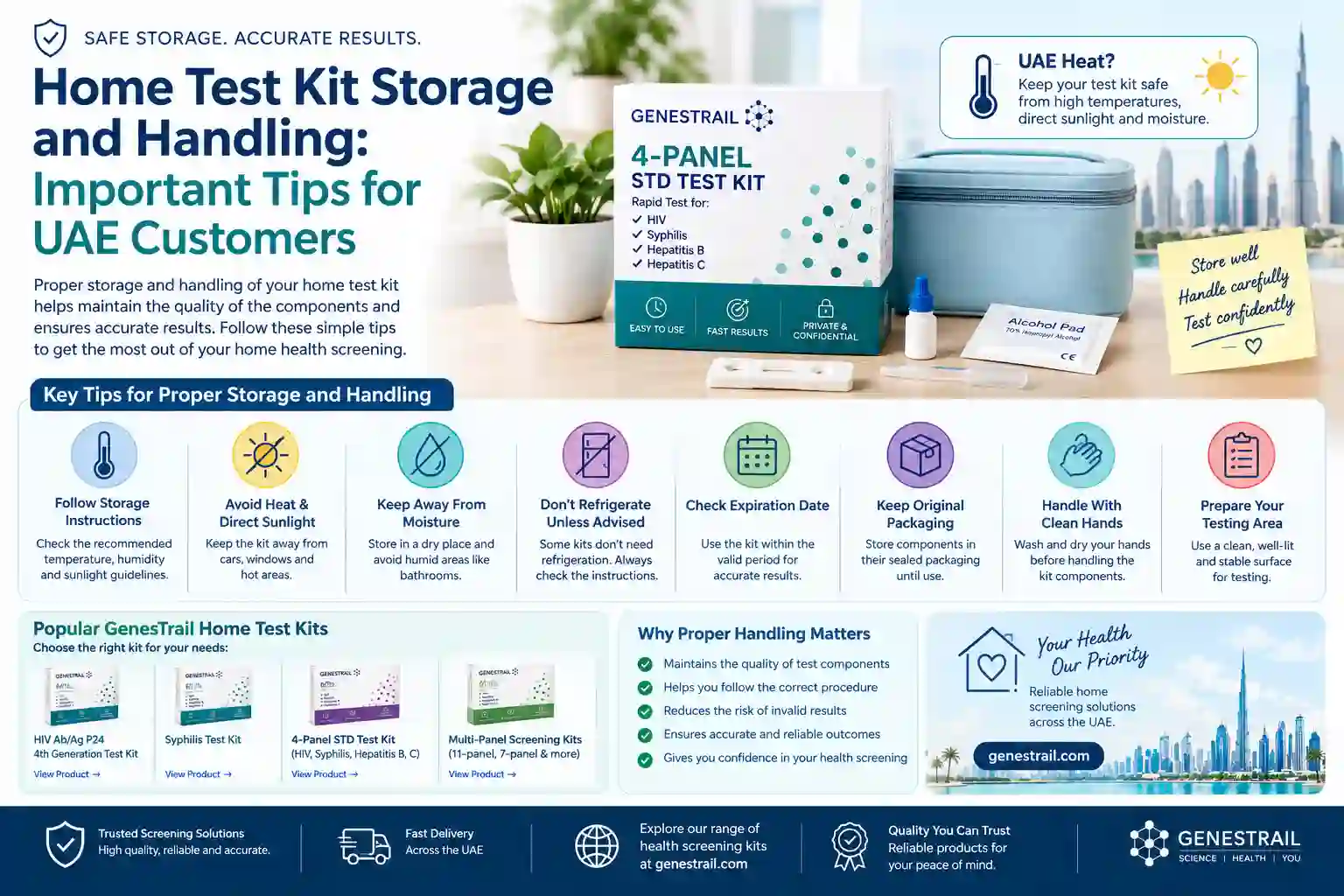
Home testing can be a convenient way to begin health screening, but proper test kit storage and handling are just as important as following the testing instructions. For customers in the UAE, where temperatures can become very high during parts of the year, paying attention to storage conditions is especially important.
Whether you have purchased an individual screening kit or a multi-panel test kit, understanding how to store, handle and prepare your kit can help you use it according to the manufacturer's instructions.
This guide explains the most important home test kit storage and handling tips for UAE customers, including temperature, sunlight, humidity, packaging, expiration dates, transportation and preparation before testing.
Why Proper Test Kit Storage Matters
Home screening kits contain components designed to work under specific conditions. Depending on the product, these may include test cassettes, collection devices, buffers, swabs, lancets or other materials.
Improper storage may affect the condition of the components and can potentially interfere with the intended testing procedure.
For this reason, customers should always check the storage information provided with their specific product rather than assuming that every test kit should be stored in exactly the same way.
1. Always Read the Storage Instructions
The first rule of home test kit storage is simple: read the manufacturer's instructions before storing or using the kit.
Look for information about:
Recommended temperature range
Humidity requirements
Protection from sunlight
Whether refrigeration is required or prohibited
Whether the kit should remain sealed
Shelf life and expiration date
Storage after opening
Instructions for individual components
Different test kits can have different requirements, so the product instructions should always take priority.
2. Protect Test Kits From Excessive Heat
Heat is an important consideration for customers in the UAE.
Avoid leaving a home test kit in places that can become extremely hot, such as:
Inside a parked car
On a vehicle dashboard
Near a window receiving direct sunlight
Near cooking appliances
In an outdoor storage area
In direct sunlight
In areas exposed to significant heat
A vehicle can become substantially hotter than the surrounding environment, particularly during hot weather.
Instead, store the unopened kit in a suitable indoor location that meets the temperature conditions specified by the manufacturer.
3. Keep the Kit Away From Direct Sunlight
Direct sunlight can create unnecessary heat and may affect some test components.
A good storage location should generally be:
Indoors
Dry
Clean
Away from direct sunlight
Away from excessive heat
Away from moisture
Do not place the kit beside a sunny window simply because the room itself feels comfortable.
4. Pay Attention to Humidity and Moisture
Moisture can be another consideration when storing testing materials.
Keep the kit away from:
Water
Wet countertops
Bathrooms with excessive humidity
Steam
Damp storage areas
Open containers of liquid
Unless the product instructions specifically state otherwise, keep individual test components in their original packaging until you are ready to use them.
5. Keep Components in Their Original Packaging
Do not unnecessarily remove test components from their sealed packaging.
Keeping components packaged helps protect them from environmental conditions and makes it easier to identify the different materials when you are ready to test.
Before opening a component, check whether the manufacturer's instructions specify that it should remain sealed until use.
6. Check the Expiration Date
Always check the expiration date before using a home test kit.
An expiration date indicates the period during which the manufacturer intends the product to remain suitable for its intended use when stored according to the stated conditions.
Before testing, check:
✓ Expiration date
✓ Packaging condition
✓ Test component condition
✓ Storage history, where relevant
If a kit is expired, do not simply assume it will perform normally. Follow the manufacturer's instructions regarding expired products.
7. Do Not Store Every Test Kit in the Refrigerator
A common misconception is that keeping medical test kits in a refrigerator automatically makes them safer.
That is not necessarily the case.
Some products have specific temperature ranges and may not require refrigeration. Others may have different storage requirements.
Never refrigerate a test kit unless the manufacturer's instructions specifically say that refrigeration is appropriate.
Likewise, do not freeze a kit unless the product instructions explicitly permit it.
Always follow the storage conditions provided for the particular product.
8. Avoid Extreme Temperature Changes
Moving a test kit repeatedly between very different temperatures may not be ideal.
For example, avoid routinely moving a kit between:
A very hot vehicle
An air-conditioned room
A refrigerator
A hot outdoor environment
unless the product instructions specifically allow such handling.
If you have questions about a kit that has been exposed to unusual temperatures, check the manufacturer's guidance before using it.
9. Handle the Test Kit With Clean Hands
Before handling test components, wash and dry your hands according to the product instructions.
This is particularly important when preparing for a test that involves sample collection.
A clean testing area and clean hands can help you follow the procedure more carefully and avoid unnecessary contamination of the testing environment.
10. Prepare Your Testing Area Before Opening the Kit
Do not open the kit and then start looking for a suitable testing area.
Instead, prepare everything first.
A suitable testing area should ideally be:
Clean
Dry
Well lit
Stable
Away from food and drinks
Large enough to organize the test components
Have the manufacturer's instructions available throughout the testing process.
11. Do Not Open Components Too Early
Many home test kits contain components that are intended to be used after opening.
Avoid opening sealed materials long before you are ready to perform the test.
Instead:
Read the instructions.
Prepare the testing area.
Gather the required materials.
Confirm the expiration date.
Open components when instructed.
Complete the test according to the stated procedure.
This simple approach can make the testing process more organized.
12. Handle Buffers and Other Liquids Carefully
Some test kits include a liquid buffer or other testing solution.
Keep these containers closed until they are required.
Avoid:
Spilling the solution
Mixing components between different kits
Using an unidentified liquid
Adding substances that are not specified in the instructions
Using a component from another test kit
Only use the materials supplied or specified for the particular test.
13. Do Not Mix Components From Different Test Kits
This is an important rule.
If you have multiple home screening kits, keep each kit's components together.
Do not use:
One kit's buffer with another kit
One test cassette with another kit's collection device
Components from an older kit with a newer kit
Unidentified accessories from another product
Each test should be performed according to its own instructions.
14. Be Careful When Transporting Test Kits
Customers sometimes need to transport a test kit after purchasing it.
During transportation, protect the package from:
Direct sunlight
Excessive heat
Water
Crushing or heavy pressure
Unnecessary temperature fluctuations
Avoid leaving a test kit inside a parked vehicle for extended periods.
If you are travelling with a kit, keep it in a suitable environment that follows the manufacturer's stated storage conditions.
15. Check the Kit After Delivery
When your home test kit arrives, inspect the package before storing it.
Check:
The outer packaging
Seals
Expiration date
Individual packaging
Test components
Instructions
If anything appears damaged, missing or compromised, consult the seller or manufacturer before using the product.
16. Store Different Test Kits Separately
If you purchase multiple screening products, organizing them can help prevent accidental mixing.
For example, you may have individual tests for different screening targets as well as a multi-panel kit.
Keep each product in its original packaging and clearly identifiable.
GenesTrail offers several individual screening options, including an HIV 4th-generation test kit:
GenesTrail HIV Ab/Ag P24 4th Generation Test Kit
For customers looking for a specific syphilis screening option:
Keeping each product organized can make preparation easier when it is time to test.
17. Consider a Multi-Panel Kit When Appropriate
If you are interested in screening for several specified targets, a multi-panel option can reduce the need to manage multiple individual products.
The GenesTrail 4-Panel Test Kit is designed to cover four specified screening targets:
HIV
Syphilis
Hepatitis B
Hepatitis C
As with any screening product, check the product information carefully to understand the specific markers, sample requirements and instructions before use.
18. What If Your Kit Was Exposed to Excessive Heat?
If you accidentally leave a test kit somewhere unusually hot, do not automatically assume that it is still suitable for use.
Instead:
Check the manufacturer's storage requirements.
Consider how long the kit was exposed to the unusual condition.
Inspect the packaging.
Contact the manufacturer or seller if you are unsure.
Follow the product-specific guidance before testing.
Avoid guessing when storage conditions have clearly been outside the stated requirements.
19. Keep Test Kits Away From Children and Pets
Home testing products should be stored responsibly.
Keep kits and components in a location that is inaccessible to children and pets.
Some kits may contain small components or sharp collection devices that should be handled carefully.
Store products safely until they are required for their intended use.
20. Follow the Instructions Even If You Have Used a Similar Kit Before
Previous experience with another home test does not necessarily mean that two kits work in exactly the same way.
Different products can have differences in:
Sample collection
Number of drops
Testing time
Result-reading window
Storage conditions
Included components
Always read the instructions for the specific product you are using.
Home Test Kit Storage Checklist for UAE Customers
Before storing your kit, use this simple checklist:
Storage
Read the manufacturer's storage instructions
Keep the kit within the recommended temperature range
Protect it from direct sunlight
Keep it away from excessive humidity
Avoid unnecessary heat exposure
Do not refrigerate unless instructed
Do not freeze unless instructed
Keep components in their original packaging
Before Testing
Check the expiration date
Inspect packaging
Confirm all components are present
Read the complete instructions
Prepare a clean testing area
Wash and dry your hands as instructed
Have a timer available if required
During Testing
Use only the components supplied for that test
Follow the sample collection procedure
Use the specified sample amount
Follow the stated testing time
Read the result within the specified time window
Common Storage Mistakes to Avoid
Leaving a Kit in a Car
A vehicle can become very hot, making it an unsuitable storage location for many temperature-sensitive products.
Storing a Kit in Direct Sunlight
Even if the room is comfortable, direct sunlight can expose the package to additional heat.
Assuming Refrigeration Is Always Better
Refrigeration is not automatically appropriate. Follow the product-specific storage instructions.
Opening Everything in Advance
Keep sealed components packaged until they are needed according to the instructions.
Mixing Components
Never combine components from different test kits.
Ignoring Damaged Packaging
If packaging appears compromised, check with the manufacturer or seller before using the product.
Forgetting the Expiration Date
Make checking the expiration date part of your normal preparation routine.
Choosing a Home Test Kit in the UAE
Storage is only one factor to consider when choosing a home screening product.
Customers should also look at:
What the test is designed to detect
Sample type
Testing procedure
Instructions
Storage requirements
Expiration information
Result interpretation
Follow-up recommendations
GenesTrail provides a range of screening products for UAE customers, including individual and multi-panel options.
Explore GenesTrail Home Screening Products
Frequently Asked Questions
Where should I store a home test kit in the UAE?
Store the kit according to the manufacturer's stated temperature and storage requirements. In general, avoid excessive heat, direct sunlight and moisture.
Can I leave a test kit in my car?
It is best to avoid leaving test kits in parked vehicles because temperatures can become very high. Follow the manufacturer's storage requirements.
Should home test kits be refrigerated?
Not unless the manufacturer specifically recommends refrigeration. Always check the product instructions.
Can I freeze a home test kit?
Do not freeze a test kit unless the manufacturer's instructions specifically state that freezing is permitted.
What should I do if the packaging is damaged?
Inspect the product carefully and contact the manufacturer or seller for guidance before using it if the packaging or individual components appear compromised.
Can I use an expired home test kit?
Do not assume that an expired test will perform as intended. Follow the manufacturer's guidance and consider using an unexpired kit.
Can components from two test kits be combined?
No. Use only the components supplied for the specific test and follow its instructions.
Does proper storage guarantee an accurate result?
Proper storage is an important part of following product requirements, but it does not by itself guarantee a particular result. Testing must also be performed according to the manufacturer's instructions, and results may require appropriate professional follow-up.
Final Thoughts
Proper home test kit storage and handling should be part of every customer's preparation routine.
For UAE residents, protecting test kits from excessive heat, direct sunlight and unsuitable storage conditions is particularly important. However, the correct storage requirements can vary between products, so always follow the manufacturer's instructions for the specific kit you have purchased.
Before testing, check the expiration date, inspect the packaging, prepare a clean testing area and make sure you understand the testing procedure.
Whether you choose an individual screening product or a multi-panel option such as the GenesTrail 4-Panel Test Kit, careful storage and correct handling can help you follow the intended testing process.
Medical disclaimer: This article is for general educational purposes and does not replace professional medical advice, diagnosis or treatment. Test kits differ in their intended use, storage requirements and testing procedures. Always follow the manufacturer's instructions and seek qualified healthcare advice when appropriate.