
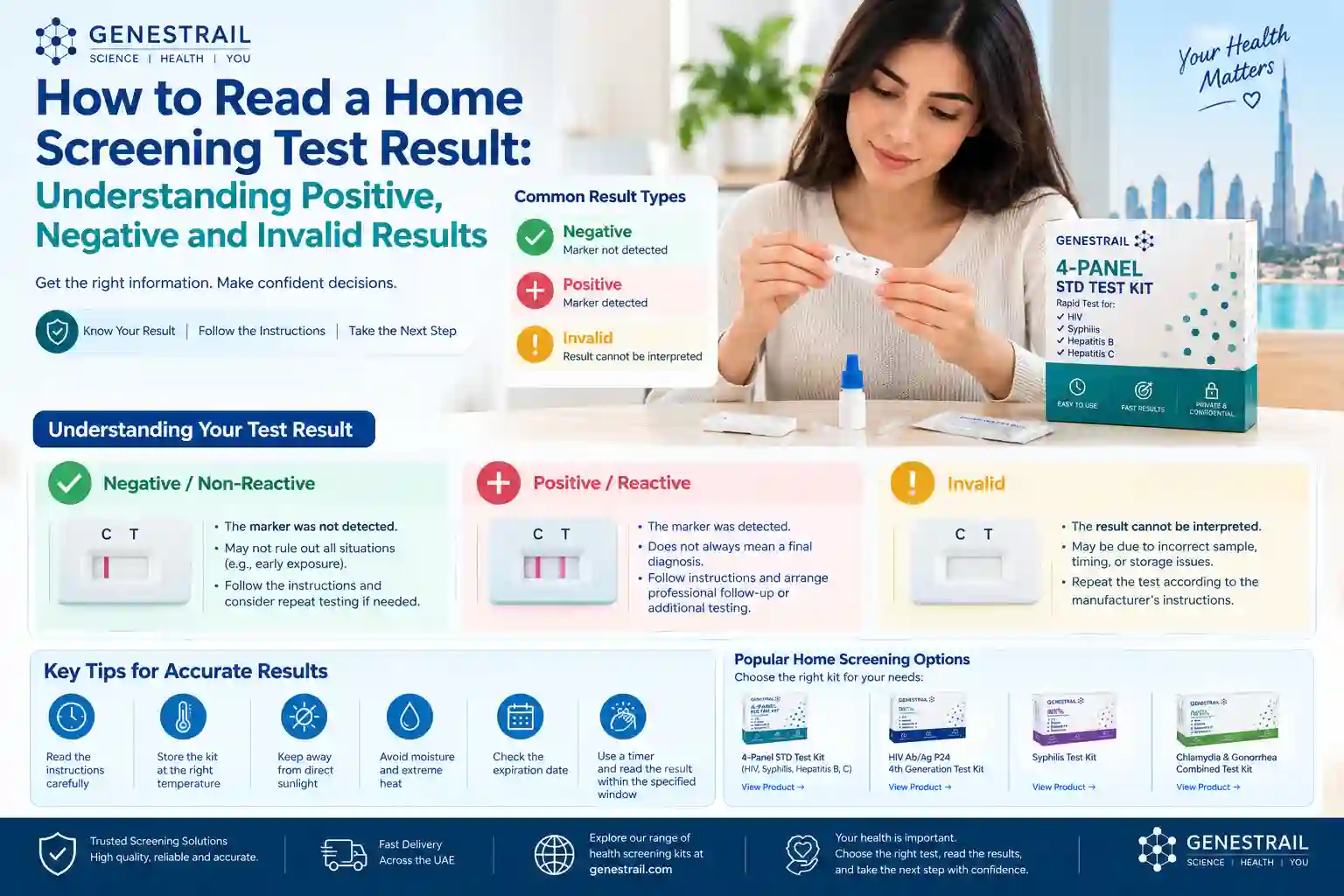
Using a home screening test can be a convenient way to begin a health screening process, but understanding the result is just as important as performing the test correctly.
Home test kits may display results as positive, negative, reactive, non-reactive or invalid, depending on the product. The meaning of each result can also vary according to what the test is designed to detect.
For UAE residents using home screening kits, it is important to read the result within the manufacturer's specified time window, follow the instructions carefully and understand when additional professional testing may be appropriate.
This guide explains how to read a home screening test result, what positive, negative and invalid results generally mean, and what steps you can consider after receiving each type of result.
Understanding the Basics of a Home Screening Test
Home screening tests are designed to detect a particular marker or target using the sample and testing method specified by the manufacturer.
Depending on the product, a test may involve:
Blood
Finger-prick blood
Other specified samples
Antibodies
Antigens
Other biological markers
Because testing methods differ, you should always use the instructions supplied with the specific product you are testing.
The FDA recommends carefully reviewing the instructions before using a home test, including information about sample collection, storage, timing, expiration dates and result interpretation.
Why Reading the Result at the Correct Time Matters
One of the most common mistakes when using a home screening test is checking the result too early or too late.
Most tests specify a particular period during which the result should be interpreted.
For example, your instructions may tell you to wait a specific number of minutes before reading the test.
Follow these basic steps:
Start the test according to the instructions.
Use a timer if recommended.
Wait for the specified amount of time.
Check the result during the stated reading window.
Do not rely on changes that appear outside the manufacturer's specified interpretation period.
Reading a test outside its intended time window can make the result difficult to interpret.
What Does a Negative or Non-Reactive Result Mean?
A negative or non-reactive result generally means that the particular marker the test is designed to detect was not detected.
However, a negative result does not necessarily answer every health question.
The interpretation can depend on:
The type of test
The target being detected
The sample used
When testing was performed
Whether the test was performed correctly
Whether a recent exposure is involved
The manufacturer's instructions
For example, CDC explains that a negative HIV test may not rule out infection if testing occurs during the test's window period. The appropriate timing for repeat testing depends on the type of HIV test used.
Therefore, do not assume that every negative home screening result has exactly the same meaning.
What Should You Do After a Negative Result?
If your result is negative:
1. Check the test instructions
Confirm that the result was read within the correct time period.
2. Consider when you tested
If the test was performed soon after a possible exposure, the appropriate next step can depend on the test type and timing.
3. Consider your symptoms and circumstances
If you have symptoms or continuing concerns, discuss them with a qualified healthcare professional.
4. Follow repeat-testing recommendations
Some testing situations require testing again after an appropriate interval.
For example, CDC notes that people with a possible recent HIV exposure may need repeat testing after the applicable window period.
What Does a Positive or Reactive Result Mean?
A positive or reactive result generally means the test detected the marker it was designed to detect.
However, a reactive screening result does not always mean that a final diagnosis has been established.
Additional testing may be necessary depending on the test.
This is particularly important for screening tests for infections.
HIV example
CDC states that when an HIV self-test is positive, the person should obtain follow-up testing with a healthcare provider to confirm the result.
Hepatitis C example
For hepatitis C, a reactive antibody test indicates that HCV antibodies were detected, but it does not by itself establish that the person currently has hepatitis C. CDC recommends follow-up HCV RNA testing to determine whether the virus is currently present.
This is why it is important to distinguish between a screening result and a confirmed diagnosis.
What Should You Do After a Positive or Reactive Result?
If your home screening result is positive or reactive:
Stay calm.
Recheck the manufacturer's instructions.
Do not treat the screening result as a final diagnosis unless the test is specifically designed and authorized for diagnostic use in the relevant setting.
Arrange appropriate follow-up testing or professional evaluation.
Tell the healthcare professional which test you used and when you performed it.
Keep the product packaging or test information available if needed.
Do not make major medical decisions based solely on a home screening result.
What Does an Invalid Result Mean?
An invalid result generally means that the test did not produce a valid interpretable result.
This is different from a negative result.
An invalid result does not mean that the test detected nothing. It means the test cannot be reliably interpreted according to its instructions.
Possible reasons can include:
Incorrect sample collection
Incorrect sample amount
Incorrect procedure
Test components not functioning as intended
Incorrect timing
Damaged packaging
Expired product
Improper storage
Another issue specified by the manufacturer
The exact reason depends on the individual product.
What Should You Do After an Invalid Result?
If your result is invalid:
Step 1: Do not interpret it as negative
An invalid test has not provided a valid result.
Step 2: Review the instructions
Check whether the manufacturer provides specific guidance for invalid results.
Step 3: Check the kit
Review the expiration date, packaging and storage conditions.
Step 4: Repeat according to the instructions
If the instructions recommend repeating the test, use the appropriate procedure and, where applicable, a new test device.
Step 5: Seek professional advice if necessary
If repeated tests remain invalid or you have health concerns, speak with a healthcare professional.
Positive vs. Negative vs. Invalid: Quick Comparison
ResultGeneral MeaningPossible Next Step
Negative / Non-reactive
The tested marker was not detected
Consider timing and instructions; repeat testing may be appropriate in some situations
Positive / Reactive
The tested marker was detected
Follow instructions and arrange appropriate follow-up when required
Invalid
The result cannot be interpreted
Review instructions and repeat according to manufacturer guidance
This table provides general guidance only. The exact meaning of a result depends on the individual test.
How to Read Lines on a Home Test Cassette
Many rapid screening cassettes use a control line and one or more test lines.
However, line patterns are not identical across all products.
Some tests may use:
A control line
A test line
Multiple test lines
Separate testing windows
Different symbols or indicators
The control line commonly helps show that the test procedure has worked correctly, but the exact interpretation must come from the product's instructions.
Never assume that the same line pattern applies to every test kit.
If you have purchased a different product, always use its specific instructions.
Why the Control Line Matters
A control indicator is commonly included to help demonstrate that the test has functioned according to its design.
If the required control indicator does not appear, the test may be invalid.
For this reason, do not interpret a test based only on whether a test line is visible.
Check the complete result interpretation section supplied with your product.
Understanding Different Types of Screening Results
Not every health screening test works in the same way.
For example, HIV tests can look for antibodies, antigen/antibody combinations or viral genetic material. CDC explains that different HIV test types have different detection windows and follow-up requirements.
Similarly, hepatitis C screening commonly begins with an HCV antibody test, with HCV RNA testing used after a reactive antibody result to determine current infection.
This means you should never interpret a result without knowing what the test is designed to detect.
Understanding the Test Window Period
The timing of testing can affect interpretation.
A window period is the period after an infection or exposure during which a test may not yet be able to detect the relevant marker.
For HIV, CDC provides different window periods depending on the test type. For example, laboratory antigen/antibody tests using blood from a vein and finger-stick antigen/antibody tests have different typical detection windows.
This is one reason why a negative result does not always eliminate the need for repeat testing when a recent exposure is suspected.
If timing is a concern, speak with a healthcare professional about the appropriate testing approach.
How to Read a 4-Panel Screening Test
A multi-panel test can include several separate screening targets.
For example, the GenesTrail 4-Panel Test Kit is designed to cover:
HIV
Syphilis
Hepatitis B
Hepatitis C
When using a multi-panel test, do not assume that all four results have exactly the same interpretation process.
Each panel may target a different marker, so read the instructions for each result carefully.
If any individual panel produces a reactive result, follow the appropriate instructions for that specific screening target.
Examples of Product-Specific Screening Options
Customers who prefer an individual screening approach can also consider specific test kits according to their screening needs.
For HIV screening, GenesTrail offers an HIV Ab/Ag P24 4th Generation Test Kit:
GenesTrail HIV Ab/Ag P24 4th Generation Test Kit
For syphilis screening, an individual option is available here:
For chlamydia screening:
GenesTrail Chlamydia Rapid Test Kit
For gonorrhea screening:
GenesTrail Gonorrhea Rapid Test Kit
For combined chlamydia and gonorrhea screening:
GenesTrail Gonorrhea & Chlamydia Combined Rapid Test Kit
These products have different intended screening targets, so always review the individual product information before testing.
Common Mistakes When Reading Home Test Results
1. Checking the Test Too Early
Some results may not be visible until the required testing period has passed.
2. Checking the Test Too Late
Changes that appear outside the specified interpretation window may not be valid for interpretation.
3. Assuming Every Test Uses the Same Lines
Different manufacturers and products can use different result formats.
4. Treating Invalid as Negative
An invalid result is not a negative result.
5. Treating a Reactive Screening Result as a Final Diagnosis
Some screening results require additional testing.
6. Ignoring Testing Timing
A test performed too early may not detect a marker that has not yet reached detectable levels.
7. Ignoring Storage Conditions
FDA recommends checking storage conditions and expiration dates before performing a home test.
How to Improve Your Home Testing Process
Before using a home screening kit:
Read all instructions
Check the expiration date
Confirm storage conditions
Inspect the packaging
Prepare a clean testing area
Have all required materials ready
Understand the result-reading window
Know what each result category means
Keep professional follow-up information available if needed
Following these steps can make the testing process easier to manage.
When Should You Seek Professional Advice?
Consider professional medical advice if:
Your result is positive or reactive
Your result is repeatedly invalid
You have symptoms
You are concerned about a recent exposure
You received a result that you do not understand
Your result conflicts with your health circumstances
You need confirmatory or follow-up testing
A healthcare professional can help determine which additional testing or evaluation may be appropriate.
Home Screening Is a Starting Point, Not Always the Final Step
Home screening can provide useful information, but it is important to understand its limitations.
A screening test may identify a marker that requires confirmation. Conversely, a negative result may need to be reconsidered when testing is performed during a relevant window period.
For example, CDC recommends follow-up testing after a positive HIV self-test, while a reactive HCV antibody result requires HCV RNA testing to determine current infection.
Understanding this distinction helps customers make better decisions about what to do next.
Frequently Asked Questions
What does a negative home test result mean?
Generally, a negative or non-reactive result means that the specific marker the test is designed to detect was not detected. However, interpretation depends on the test type and timing.
Does a positive home screening test confirm an infection?
Not necessarily. Some screening tests require follow-up or confirmatory testing. For example, a positive HIV self-test requires follow-up testing, and a reactive HCV antibody result requires HCV RNA testing to determine current infection.
What does an invalid home test result mean?
It generally means the test did not produce a valid interpretable result. Follow the manufacturer's instructions for repeating the test.
Can I read the result after the recommended time?
You should follow the manufacturer's specified reading window. Results viewed outside that window may not be reliable for interpretation.
Why is the control line important?
The control indicator generally helps show that the test has functioned according to its design. If the required control indicator does not appear, the test may be invalid.
Can a negative result be wrong?
A negative result may not detect an infection in some circumstances, including when testing is performed during a relevant window period. The significance depends on the test and the timing.
What should I do if I get a reactive result?
Follow the product instructions and arrange appropriate professional follow-up or additional testing when recommended.
Can I use a multi-panel test for broader screening?
Yes, a multi-panel kit can be an option when its included screening targets match your needs. Review each panel's intended use and result instructions carefully.
Final Thoughts
Knowing how to read a home screening test result is an important part of responsible home testing.
A negative or non-reactive result generally means the specific marker was not detected, while a positive or reactive result means the test detected the marker it was designed to identify. An invalid result means that the test cannot be interpreted and may need to be repeated.
However, these terms should not be interpreted in isolation. The specific test, sample type, timing, storage conditions and manufacturer's instructions all matter.
For UAE customers using individual or multi-panel screening kits, always read the product instructions carefully and understand what your particular test is designed to detect.
If a result is reactive, unclear, repeatedly invalid or inconsistent with your circumstances, appropriate professional follow-up is an important next step.
Medical disclaimer: This article is for general educational purposes and does not replace professional medical advice, diagnosis or treatment. Home screening products differ in their intended use, testing methods and interpretation. Always follow the manufacturer's instructions and seek qualified healthcare advice when appropriate.