
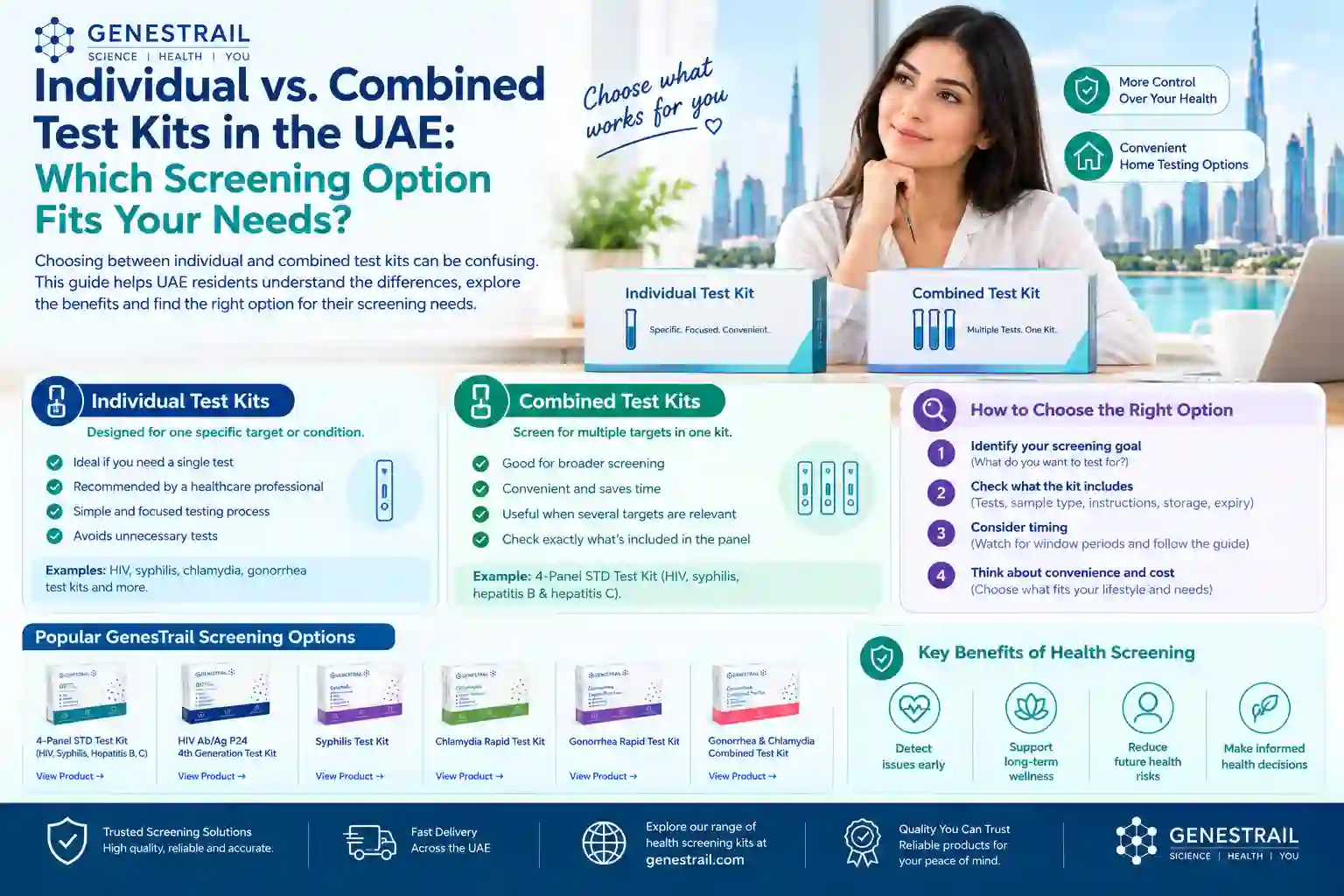
Choosing a health screening test can sometimes feel confusing, especially when you have the option of selecting an individual test kit or a combined test kit.
Individual test kits are designed to focus on one specific screening target, while combined or multi-panel kits can cover several targets within one testing format. The better choice depends on your screening goals, personal circumstances, the tests included, and the instructions provided with the product.
For UAE residents considering home screening, understanding the difference between individual and combined test kits can make it easier to choose an option that matches their needs.
What Is an Individual Test Kit?
An individual test kit is designed to screen for one specific target or condition.
For example, someone specifically looking for syphilis screening may choose a dedicated syphilis test kit, while someone interested in a particular type of HIV screening may select an HIV-specific test.
Individual kits can be useful when:
You only want to screen for one specific target.
A healthcare professional has recommended a particular test.
You want a focused testing option.
You already have results for other screening targets.
You want to avoid purchasing tests that are not relevant to your situation.
A focused test can make the testing process easier to understand because you are concentrating on one screening purpose.
What Is a Combined Test Kit?
A combined test kit, sometimes called a multi-panel test kit, is designed to screen for more than one target using a single product.
For example, a 4-panel screening kit may combine HIV, syphilis, hepatitis B, and hepatitis C screening into one kit.
This type of option may be useful for people who want broader screening rather than focusing on only one target.
However, the fact that a kit covers multiple targets does not automatically mean it is the right choice for everyone. Always check exactly what the product is designed to detect and whether it is appropriate for your circumstances.
Individual vs. Combined Test Kits: At a Glance
FeatureIndividual Test KitCombined Test Kit
Screening focus
One target
Multiple targets
Best suited for
Specific screening needs
Broader screening needs
Number of targets
Usually one
Two or more
Convenience
Simple and focused
Multiple screening options in one kit
Product selection
Target-specific
Panel-specific
Cost consideration
Pay for a specific test
May combine several screening targets
Result interpretation
Focused on one target
Requires checking each included target
Ideal for
Targeted screening
Broader screening
The best choice depends on your reason for testing rather than simply the number of targets included.
When Should You Choose an Individual Test Kit?
An individual kit can make sense when you already know which screening target you want to assess.
1. You Have a Specific Screening Goal
If you are specifically looking for one condition, an individual test may be a straightforward option.
For example, someone looking specifically for syphilis screening may prefer a dedicated syphilis test rather than purchasing a multi-panel kit.
GenesTrail offers a dedicated Syphilis Test Kit for users looking for a focused screening option.
2. You Have Already Completed Other Screening
If you recently completed other screening and only need to consider one additional target, purchasing another individual test may be more practical than choosing a larger panel.
3. You Want a Simple Testing Process
A single-target kit can be easier to understand because the product has one primary screening purpose.
That can be particularly useful for people who are new to home testing and want to focus on one test at a time.
When Might a Combined Test Kit Be Useful?
A combined test kit may be worth considering when you want to assess multiple screening targets.
1. You Want Broader Screening
If you are interested in several screening targets, a multi-panel kit can bring them together in one product.
GenesTrail's 4-Panel STD Test Kit includes screening for HIV, syphilis, hepatitis B, and hepatitis C.
This can be a convenient option for someone looking for broader screening rather than purchasing several individual kits separately.
2. You Want One Multi-Target Option
A combined kit can simplify product selection when several targets are relevant to your screening goals.
Instead of selecting several separate products, you can review one panel and determine whether its included targets match what you need.
3. You Want to Compare Several Screening Targets
A multi-panel test can provide a broader screening approach, but each result still needs to be interpreted according to the manufacturer's instructions.
A reactive result for one target should not automatically be assumed to apply to the other targets included in the same panel.
Individual Tests Can Also Be a Good Choice
Combined testing receives attention because it can be convenient, but individual testing has its own advantages.
An individual kit may be preferable when:
You need only one specific test.
Your healthcare professional has recommended one particular screening target.
You have already completed other tests.
You want to keep your testing focused.
The combined panel contains targets that are not relevant to your situation.
The goal should be to choose an appropriate test rather than simply choosing the kit with the largest number of screening targets.
Examples of Individual Screening Options
Depending on your needs, different individual screening kits may be available.
HIV Screening
An HIV-specific test may be considered when HIV screening is the primary focus.
GenesTrail offers an HIV Ab/Ag P24 4th Generation Test Kit designed around HIV antigen/antibody screening.
The type of HIV test matters because different HIV tests detect different markers and have different window periods. Testing too soon after a potential exposure may affect what a negative result means.
Syphilis Screening
For people specifically considering syphilis screening, an individual syphilis test may be more appropriate than a broader panel if other targets are not needed.
Chlamydia Screening
A dedicated Chlamydia Rapid Test Kit can be considered when chlamydia screening is specifically what you are looking for.
Gonorrhea Screening
A Gonorrhea Rapid Test Kit provides a focused option for people looking specifically at gonorrhea screening.
Combined Chlamydia and Gonorrhea Screening
For people interested in both targets, a combined Gonorrhea and Chlamydia Test Kit can provide a multi-target option focused specifically on these two conditions.
How to Choose Between Individual and Combined Test Kits
Before purchasing a screening kit, ask yourself a few simple questions.
Step 1: Identify Your Screening Goal
Start by asking:
What exactly do I want to screen for?
If you have one specific target in mind, an individual kit may be sufficient.
If you want broader screening, a combined panel may be more suitable.
Step 2: Check What the Kit Includes
Do not assume that every combined kit covers the same conditions.
Read the product description and packaging carefully to confirm:
Which targets are included
The type of sample required
Intended users
Testing procedure
Result interpretation
Storage conditions
Expiration information
Step 3: Consider Timing
Testing at the appropriate time can be important.
Some screening tests have a window period during which a marker may not yet be detectable. Therefore, a negative result obtained too soon after a potential exposure may not provide the information you expect.
If you are concerned about a recent exposure, ask a healthcare professional which test and testing time are appropriate.
Step 4: Consider Convenience
Think about whether you prefer:
One focused test
Several individual tests
One multi-panel kit
Home testing
Professional testing at a healthcare facility
Convenience is useful, but it should not replace consideration of whether the test is appropriate for your situation.
What About Cost?
Cost can also influence the decision between individual and combined kits.
An individual kit may be more economical when you only need one specific screening target.
A combined kit may be attractive when you genuinely want to screen for several targets and prefer having them together.
However, price should not be the only consideration. Look at the targets included, intended use, instructions, sample type, storage requirements, and available follow-up options.
Home Testing in the UAE
Home testing can provide privacy and convenience for certain screening needs.
The FDA notes that home-use tests can help people assess certain health conditions at home, but they should not replace regular healthcare visits or appropriate professional evaluation. Following the manufacturer's instructions carefully is also important because incorrect timing, sample collection, storage, or interpretation can affect results.
For UAE residents, the same practical principle applies: understand what the product is intended to do before using it and know what steps to take after receiving a result.
How to Get Better Results From a Home Test Kit
Regardless of whether you choose an individual or combined kit, careful testing matters.
Read the Instructions First
Do not begin testing before reading the complete instructions.
Check:
Sample requirements
Number of drops or sample quantity
Test timing
Result-reading window
Storage instructions
Expiration date
Invalid-result instructions
Check the Kit Before Use
Make sure the packaging is intact and the components appear suitable for use.
Do not use a product that is expired or has been stored contrary to its instructions.
Follow the Timing Carefully
Many rapid tests require the result to be read within a specific time window.
Reading a test too early or too late can make interpretation unreliable.
Understand That Screening Is Not Always Diagnosis
A screening test is generally an initial assessment rather than a complete diagnostic evaluation.
A reactive result may require follow-up testing or professional evaluation. Similarly, a negative result may not completely rule out a condition in every circumstance, particularly when testing is performed during a relevant window period.
Individual or Combined: Which One Is Better?
There is no universal winner.
Choose an Individual Test If:
You need one specific screening target.
You have been advised to test for one condition.
You have already screened for other targets.
You prefer a focused testing process.
Consider a Combined Test If:
You want broader screening.
Several targets are relevant to your situation.
You prefer a multi-panel option.
You want multiple screening targets included in one product.
The most important factor is whether the test matches your actual screening needs.
GenesTrail Screening Options in the UAE
GenesTrail provides a range of individual and combined screening options for customers in the UAE.
For broader screening, the 4-Panel STD Test Kit includes HIV, syphilis, hepatitis B, and hepatitis C.
For more focused screening, options include HIV, syphilis, chlamydia, and gonorrhea test kits.
This range allows customers to consider either a targeted or broader approach depending on their individual screening goals.
When Should You Speak With a Healthcare Professional?
Home screening can be useful in appropriate circumstances, but professional medical advice is important when:
You have symptoms.
You receive a reactive or positive screening result.
You are concerned about a recent exposure.
You are unsure which test is appropriate.
You receive repeated invalid results.
You need confirmatory or follow-up testing.
You have questions about the timing of testing.
You are pregnant or planning pregnancy and need condition-specific screening advice.
If you are unsure what a result means, do not make important medical decisions based only on a home screening result.
Frequently Asked Questions
Are combined test kits better than individual test kits?
Not necessarily. Combined kits can be convenient for broader screening, while individual kits can be more appropriate when you only need one specific screening target.
What is the main advantage of an individual test kit?
The main advantage is focused screening. You can select a test designed for the specific target you want to assess.
What is the main advantage of a combined test kit?
A combined kit can provide multiple screening targets within one product, which may be convenient for people looking for broader screening.
Can I use a combined test kit instead of visiting a doctor?
A home screening kit should not automatically replace professional healthcare. If you have symptoms, risk factors, concerns about exposure, or a reactive result, professional evaluation may be appropriate.
Should I choose a 4-panel test or individual tests?
It depends on what you want to screen for. If several targets included in the 4-panel kit are relevant to you, a combined option may be convenient. If you only need one target, an individual test may be more suitable.
Can a negative result completely rule out a condition?
Not necessarily. The meaning of a negative result depends on the specific test, timing, sample, and other circumstances. Always follow the manufacturer's instructions and seek professional advice when appropriate.
Final Thoughts
Choosing between individual and combined test kits in the UAE comes down to your screening goals.
Individual kits can be a practical choice when you want to focus on one specific target. Combined kits can be convenient when you want broader screening across several targets.
Before choosing a product, check exactly what it detects, how it is used, what sample is required, how results are interpreted, and whether the timing is appropriate for your circumstances.
GenesTrail offers both focused and multi-panel screening options, allowing UAE customers to explore different testing approaches based on their individual needs.
The most important thing is not choosing the kit with the most tests—it is choosing a test that is appropriate for the screening purpose and using it correctly.
Medical disclaimer: This article is provided for general educational purposes and does not replace professional medical advice, diagnosis, or treatment. Screening recommendations and follow-up requirements can vary according to the individual, the condition being assessed, and the specific test used.