
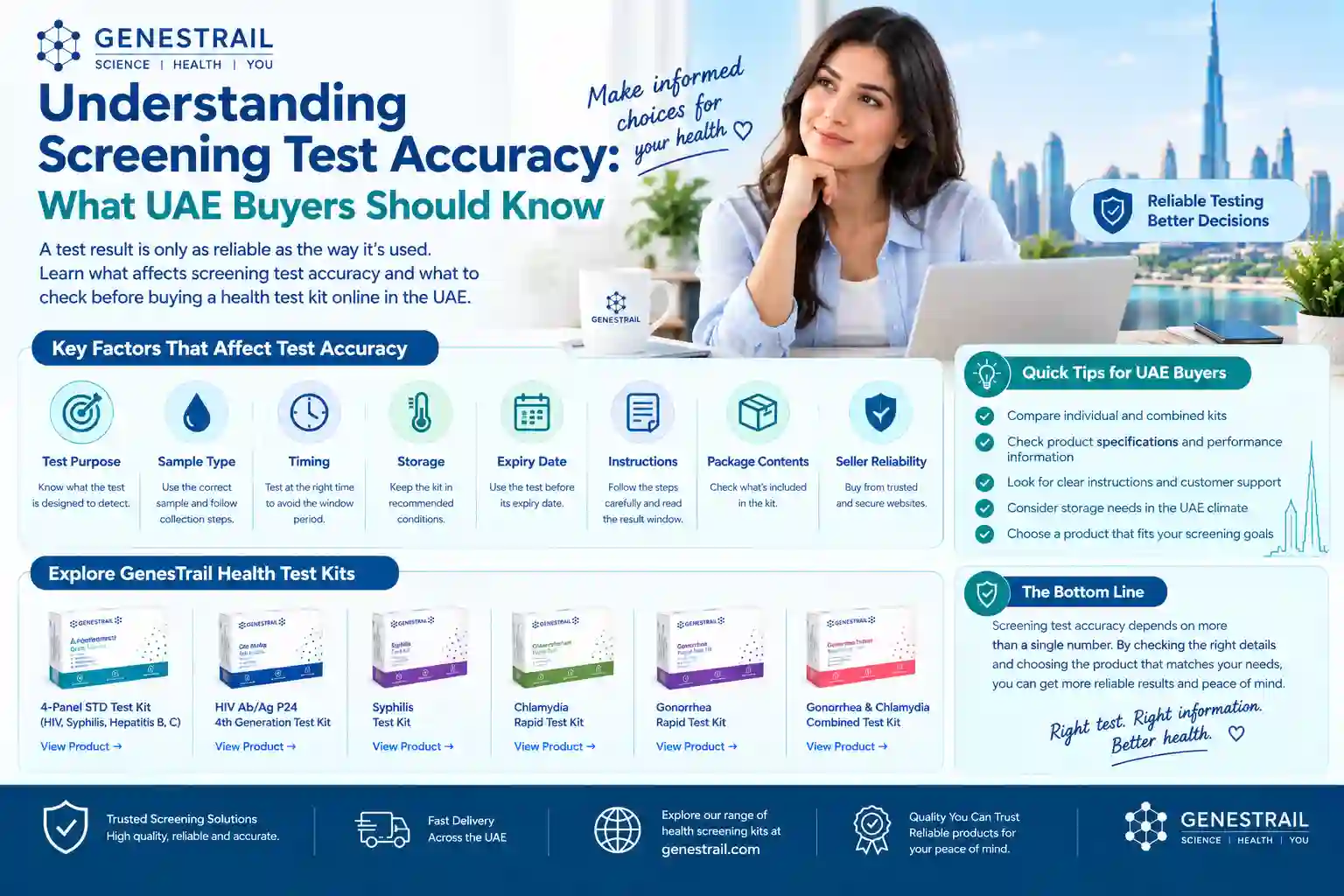
When buying a health screening test online, one of the first questions many people ask is: How accurate is the test?
Understanding screening test accuracy is important because a test result can be influenced by several factors, including the type of test, when it is performed, how the sample is collected, storage conditions, and whether the instructions are followed correctly.
For UAE buyers considering home screening products, looking beyond a simple accuracy percentage can help you understand what a test can—and cannot—tell you.
What Does Test Accuracy Mean?
Test accuracy refers to how closely a test result agrees with the true condition being assessed.
However, accuracy is not the only measure used to understand test performance. Two important terms are sensitivity and specificity.
Sensitivity
Sensitivity describes how well a test identifies people who actually have the condition being tested for.
A test with higher sensitivity is generally better at detecting the target condition when it is present.
Specificity
Specificity describes how well a test correctly identifies people who do not have the condition being tested for.
Both sensitivity and specificity are important when evaluating diagnostic or screening tests.
The FDA describes sensitivity as the proportion of people with the target condition who test positive, while specificity refers to the proportion of people without the condition who test negative.
Screening Accuracy Is More Than a Percentage
When shopping for a screening test online, you may see performance percentages in product information. These numbers can be useful, but they should not be viewed in isolation.
A test's performance can depend on:
The specific test design
The target being detected
The sample type
The testing population
Timing of testing
Sample collection
Storage conditions
User technique
Following the manufacturer's instructions
The reference method used for comparison
This is why buyers should read the complete product information rather than choosing a product based only on a single accuracy figure.
Sensitivity and Specificity Are Different
Consider a simple example.
Imagine a screening test designed to identify a particular condition.
If the test is highly sensitive, it may be effective at identifying many people who have that condition.
If it is highly specific, it may be effective at correctly identifying people who do not have the condition.
Neither number alone tells the entire story.
This is particularly important when comparing different test types or deciding whether a home screening test is appropriate for a particular situation.
What Can Affect the Accuracy of a Home Screening Test?
Even when a test has been designed and evaluated for its intended purpose, the way it is used can affect the result.
1. Testing Too Early
Some conditions have a window period, meaning there can be a period after an infection or other event when a test may not yet be able to detect the target.
This means that a negative result obtained too early may not provide the information someone expects.
HIV is a clear example. Different HIV tests have different window periods, and CDC guidance explains that the timing varies according to the type of test used.
2. Incorrect Sample Collection
A home screening test may require a particular type and amount of sample.
Collecting too little sample, using the wrong collection method, or contaminating the sample can interfere with testing.
Always follow the collection instructions supplied with the specific product.
3. Incorrect Timing
Rapid screening tests often specify exactly when the result should be read.
Reading the result too early or outside the manufacturer's specified interpretation period can make the result difficult to interpret.
4. Improper Storage
Temperature, moisture, sunlight and other storage conditions can affect some test components.
Before using a kit, check its storage requirements and expiration date.
5. Expired Products
Always check the expiration date before using a screening test.
An expired product should not be assumed to perform in the same way as a product within its stated shelf life.
6. User Interpretation
Some screening tests use lines, symbols or other visual indicators.
The control indicator and result indicators need to be interpreted according to the product's instructions.
If you are uncertain about the result, do not guess.
Why Following Instructions Matters
The FDA advises home-test users to carefully read the label and instructions, understand how to collect the sample, follow timing requirements, check storage conditions and expiration dates, and understand how the result should be interpreted.
Following the instructions is not just a formality. It is part of obtaining a meaningful test result.
For UAE customers buying health test kits online, reviewing the instructions before purchasing can also help determine whether the product is suitable for their intended use.
What Is a False Negative?
A false negative occurs when a test indicates that a target condition is not present when it actually is.
Several factors can contribute to false-negative results, including:
Testing during a window period
Incorrect sample collection
Incorrect testing procedure
Test limitations
Storage problems
Other factors that interfere with the test
A negative result should therefore be interpreted in the context of the specific test and the circumstances in which it was performed.
What Is a False Positive?
A false positive occurs when a test indicates that a target condition is present when it is actually not.
False positives can occur for different reasons depending on the test.
This is why a reactive screening result should not automatically be treated as a final diagnosis.
Depending on the specific condition and test, follow-up or confirmatory testing may be recommended.
Screening Test vs. Diagnostic Test
One of the most important concepts for online buyers is understanding the difference between screening and diagnosis.
A screening test is generally an initial or preliminary test. Its purpose is to identify whether further evaluation may be appropriate.
A diagnostic process can involve additional testing, clinical assessment, medical history and other information.
The FDA defines a screening test as an initial or preliminary test and notes that a positive screening result may require additional testing or evaluation.
Therefore, customers should avoid interpreting a screening product as a substitute for a complete medical assessment.
Understanding HIV Screening Accuracy
HIV testing is an area where testing timing is particularly important.
Different HIV tests detect different markers and therefore have different window periods.
CDC guidance states that antibody tests generally have a longer window period than some antigen/antibody tests, while laboratory-based testing can differ from finger-stick or self-testing methods.
For customers specifically looking for an HIV screening option, the GenesTrail HIV Ab/Ag P24 4th Generation Test Kit is one product option to review.
Before using any HIV screening product, read its intended use, sample requirements, testing procedure and timing information carefully.
Understanding Multi-Panel Screening
Some buyers prefer a combined test because they want to screen for several targets using one multi-panel product.
GenesTrail offers a 4-Panel STD Test Kit covering HIV, syphilis, hepatitis B and hepatitis C.
A multi-panel product can be convenient when several listed targets are relevant to the intended screening purpose.
However, broader coverage does not automatically mean a product is appropriate for every person. Buyers should review exactly what the panel contains and whether those targets match their intended screening needs.
Individual Screening Tests
An individual screening kit may be more suitable when the buyer is looking for a specific testing option.
For example, GenesTrail provides a Syphilis Test Kit for customers specifically looking for syphilis screening.
Similarly, individual products are available for chlamydia and gonorrhea screening.
Choosing an individual product can make sense when the screening goal is focused on one particular target.
Chlamydia and Gonorrhea Screening Options
GenesTrail provides individual Chlamydia Rapid Test Kit and Gonorrhea Rapid Test Kit options.
There is also a Gonorrhea & Chlamydia Combined Rapid Test Kit for customers looking for a combined option covering both listed targets.
Before choosing between individual and combined products, check the product's intended use, sample requirements and instructions.
How UAE Buyers Can Compare Test Accuracy
When comparing health test kits online, use a structured approach.
Step 1: Identify the Screening Target
Know exactly what you want the test to screen for.
Step 2: Check the Test Type
Determine whether the product is an individual test, combined test, rapid test, laboratory-based test or another type.
Step 3: Review Performance Information
If sensitivity, specificity or other performance information is provided, read the context in which those figures were established.
Step 4: Check the Sample Type
Make sure you understand whether the test requires blood, urine, a swab or another type of specimen.
Step 5: Review the Testing Window
Check whether the manufacturer provides information about when the test should be performed.
Step 6: Check Storage and Expiry
Confirm that the product has been stored correctly and is within its stated expiry period.
Step 7: Read the Result Instructions
Understand how negative, reactive and invalid results are defined for that specific product.
Is a More Expensive Test Always More Accurate?
Not necessarily.
Price alone does not establish the accuracy or suitability of a health screening test.
Two products can differ in their technology, intended use, sample type, number of screening targets, packaging and testing procedure.
Instead of choosing solely according to price, compare the information provided about:
Intended use
Test target
Sample type
Performance
Instructions
Storage
Expiry
Package contents
Testing limitations
Can a Negative Result Be Wrong?
Yes, depending on the specific test and circumstances.
A negative result can sometimes occur even when the target condition is present. This can happen if testing occurs during a window period, the sample is not collected correctly, instructions are not followed, or other factors affect the test.
For HIV testing, CDC specifically notes that a negative result during the window period may not rule out infection and recommends repeat testing according to the type of test and timing.
If you have ongoing concerns, symptoms or a recent potential exposure, discuss the appropriate testing approach with a healthcare professional.
Can a Positive Result Be Wrong?
A reactive or positive screening result does not always represent a final diagnosis.
Some screening tests are designed to identify people who may need additional evaluation.
For HIV self-testing, CDC recommends follow-up testing after a positive self-test to confirm the result.
The appropriate next step depends on the specific test and condition, so follow the product instructions and seek professional guidance when required.
What Does an Invalid Result Mean?
An invalid result generally means the test did not produce a valid result.
Possible reasons can include:
Insufficient sample
Incorrect testing procedure
Incorrect timing
Test device problems
Storage issues
Do not interpret an invalid result as either positive or negative.
Follow the manufacturer's instructions to determine whether you should repeat the test with a new kit or seek another testing method.
How to Get the Most Reliable Result Possible
You can reduce avoidable testing errors by following a few simple steps:
Check the expiry date.
Read the complete instructions before starting.
Store the kit according to the manufacturer's requirements.
Prepare the required materials.
Collect the correct sample.
Use the correct amount of sample.
Follow the specified testing procedure.
Use a timer when required.
Read the result within the specified time.
Keep the instructions available when interpreting the result.
These steps cannot guarantee a particular outcome, but they can help reduce errors caused by incorrect use.
What Should You Look for When Buying a Test Kit Online in the UAE?
Before purchasing, check:
What the test detects
Intended use
Sample type
Test procedure
Performance information
Testing window
Storage requirements
Expiration date
Package contents
Result interpretation
Seller information
Customer support
A reliable purchasing decision starts with understanding the product rather than relying on a single marketing claim.
Frequently Asked Questions
Are home screening tests accurate?
Home screening tests can provide useful screening information when they are appropriate for their intended use and performed correctly. However, no test should be assumed to be perfect, and results can be affected by timing, sample collection, storage and other factors.
What is the difference between sensitivity and specificity?
Sensitivity describes how well a test identifies people who have the target condition. Specificity describes how well it correctly identifies people who do not have the target condition.
Does a negative result mean I definitely do not have a condition?
Not always. The meaning of a negative result depends on the test, timing, sample collection, window period and other factors.
Does a positive screening result mean I definitely have the condition?
Not necessarily. Some screening results require follow-up or confirmatory testing before a diagnosis can be established.
What should I do after an invalid result?
Follow the instructions for the specific test. You may need to repeat the test with a new kit or obtain professional testing.
Does testing too early affect accuracy?
It can. Some conditions have window periods during which a test may not yet detect the target. Check the specific test's instructions and relevant medical guidance.
How should I choose a screening test online in the UAE?
Start by identifying what you want to screen for, then compare the test type, sample requirements, performance information, timing, storage conditions, expiry and instructions.
Final Thoughts
Understanding screening test accuracy is an important part of choosing a health test kit online.
Rather than focusing only on a single accuracy percentage, UAE buyers should consider the complete picture: sensitivity, specificity, timing, sample collection, storage, expiry, instructions and the intended use of the test.
Home screening can be a convenient option for certain situations, but it should be viewed as part of a broader approach to personal healthcare. A reactive result may require additional evaluation, while a negative result may need to be considered in relation to testing timing and other circumstances.
When choosing a screening product, take time to read the product information and follow the manufacturer's instructions carefully.
Medical Disclaimer: This article is provided for general educational purposes and is not a substitute for professional medical advice, diagnosis or treatment. Always follow the instructions supplied with the specific test kit and consult a qualified healthcare professional if you have symptoms, concerns about your health, questions about testing or a result that requires follow-up.
HIV Ab/Ag P24 4th Generation Test Kit: GenesTrail HIV Ab/Ag P24 4th Generation Test Kit
- 4-Panel STD Test Kit: GenesTrail 4-Panel STD Test Kit
- Syphilis Test Kit: GenesTrail Syphilis Test Kit
- Chlamydia Rapid Test Kit: GenesTrail Chlamydia Rapid Test Kit
- Gonorrhea Rapid Test Kit: GenesTrail Gonorrhea Rapid Test Kit
- Gonorrhea & Chlamydia Combined Rapid Test Kit: GenesTrail Combined Gonorrhea & Chlamydia Test Kit