
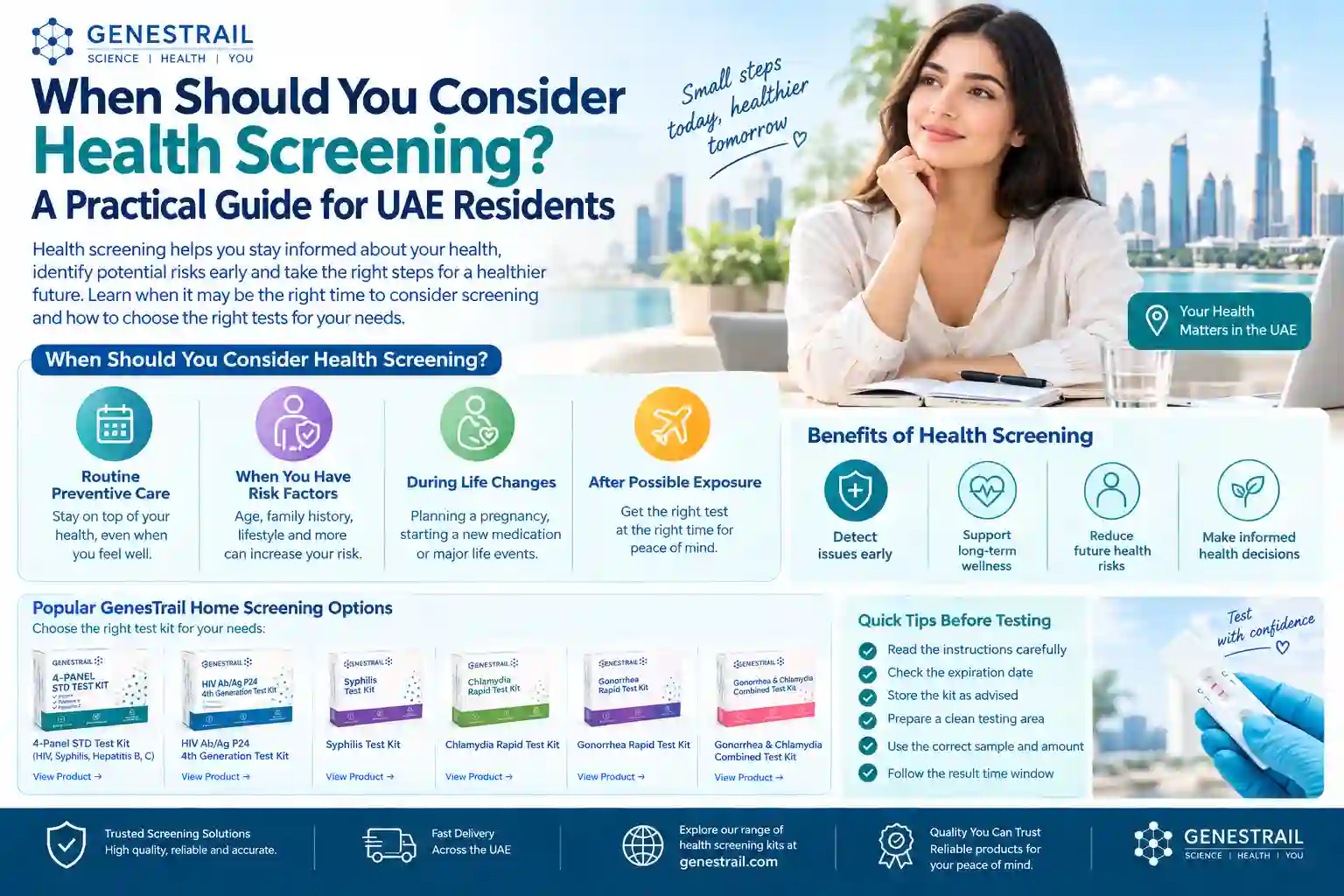
Taking care of your health is not only about visiting a doctor when you feel unwell. Regular health screening can help you understand important aspects of your health and identify certain conditions that may need further attention.
For UAE residents, health screening can be a practical part of maintaining long-term wellness, especially when screening is selected according to age, personal risk factors, family history, lifestyle, and healthcare guidance.
Whether you are considering routine health checks, infectious-disease screening, or a home testing option, understanding when health screening may be appropriate can help you make better-informed decisions.
What Is Health Screening?
Health screening refers to testing people who may not have noticeable symptoms to look for signs or risk factors associated with particular health conditions.
Screening is different from diagnostic testing. A screening result may indicate that further evaluation is appropriate, but it does not necessarily provide a final diagnosis.
The type and frequency of screening should depend on the condition being assessed and the individual's age, risk factors, medical history, and healthcare recommendations.
Why Is Health Screening Important?
Some health conditions may develop without obvious symptoms, particularly during their early stages. Preventive healthcare can help people stay informed about their health and seek appropriate medical advice when something requires attention.
Routine preventive care can include:
Blood pressure checks
Blood glucose or diabetes screening
Cholesterol testing
Cancer screening when appropriate
Infectious-disease screening
Vaccination and preventive-care reviews
Health assessments based on age and risk factors
The right screening plan is not the same for everyone. A healthcare professional can help determine which tests are appropriate for you.
When Should You Consider Health Screening?
There is no single age or schedule that applies to every person. However, several situations may be good reasons to discuss screening with a healthcare professional.
1. As Part of Routine Preventive Care
Even when you feel healthy, routine health assessments can help you keep track of important health indicators.
Regular preventive care may include checking blood pressure, blood sugar, cholesterol, weight, and other factors depending on your age and personal health profile.
Instead of waiting until you notice a problem, routine screening can become part of a broader approach to maintaining your health.
2. When You Have Relevant Risk Factors
Your need for screening may be influenced by factors such as:
Age
Family health history
Lifestyle
Smoking
Weight and physical activity
Previous health conditions
Certain medications
Occupational exposures
Travel history
Other individual risk factors
If you have one or more relevant risk factors, ask a healthcare professional whether you should be screened more frequently or whether additional tests are appropriate.
3. Before or During Major Life Changes
Some people may consider a health assessment before major life events.
For example, you may want to discuss screening with a healthcare professional before:
Starting a new long-term lifestyle plan
Planning a pregnancy
Beginning certain medications
Preparing for an important work or travel requirement
Reviewing your health after a significant change in lifestyle
The appropriate tests will depend on your circumstances.
4. When You Have Had a Potential Exposure
Certain types of screening may be appropriate after a potential exposure to an infectious condition.
The correct test and testing time can vary significantly depending on the condition. Some tests may not detect a condition immediately after exposure because markers can take time to become detectable.
For this reason, testing too early can sometimes produce a result that does not provide the complete picture.
If you are concerned about a recent exposure, speak with a healthcare professional about the appropriate test and timing.
Health Screening for UAE Residents
The UAE has a broad healthcare system with preventive services available through healthcare facilities across the country.
For UAE residents, health screening may involve different types of assessments depending on age, gender, personal history, and individual risk factors.
For example, UAE national guidance includes organized screening programs for specific conditions. Cervical cancer screening recommendations in the UAE are based on age and risk factors, with different intervals for different age groups.
This highlights an important point: screening should be personalized rather than based on a one-size-fits-all schedule.
Home Health Screening: When Can It Be Useful?
Home screening kits can provide a convenient option for certain types of screening, particularly when privacy and convenience are important to the user.
Depending on the specific product, home screening may involve collecting a sample and using a test device according to the manufacturer's instructions.
Before choosing a home test, consider:
What the test is designed to detect
What type of sample is required
Whether the test is suitable for your situation
The manufacturer's instructions
Storage requirements
Expiration date
Recommended testing time
How results should be interpreted
What follow-up is recommended if the result is reactive or unclear
Home screening should complement appropriate healthcare rather than replace professional medical advice when it is needed.
Choosing the Right Home Screening Kit
There are different types of screening kits designed for different purposes. Selecting a product based only on the number of tests included may not be the best approach.
Instead, first identify what you actually want to screen for.
Single-Target Screening
A single-target test may be appropriate when you are specifically interested in one condition.
For example, a dedicated syphilis screening kit may be more suitable when syphilis screening is specifically what you are looking for.
Multi-Panel Screening
A multi-panel kit can combine several screening targets into one testing format.
For people looking for broader screening, a 4-panel test kit can cover multiple targets in one product. Always review the product information carefully to understand exactly what the kit is designed to detect.
When a 4-Panel Screening Kit May Be Considered
For users looking for broader screening, GenesTrail offers a 4-Panel STD Test Kit designed to screen for HIV, syphilis, hepatitis B, and hepatitis C.
A multi-panel option may be convenient when someone wants to consider several screening targets rather than purchasing separate kits.
However, a multi-panel screening kit should still be selected according to the individual's circumstances, and any reactive result may require appropriate follow-up testing.
Other Home Screening Options
Depending on your screening needs, you may also consider individual testing products.
For example, GenesTrail provides different screening options for:
HIV
Syphilis
Chlamydia
Gonorrhea
Hepatitis-related screening
Multi-panel screening
The right option depends on what you are trying to assess and whether home screening is appropriate for your situation.
Should You Screen If You Have No Symptoms?
In some situations, screening can be appropriate even when you feel completely healthy.
The purpose of screening is not necessarily to find a problem that is causing symptoms. Certain screening programs are designed specifically for people who may not have noticeable symptoms.
However, not every condition benefits from routine screening for every person. Screening decisions should be based on evidence, age, risk factors, and appropriate healthcare guidance.
If you have symptoms, do not rely only on a home screening kit. Speak with a qualified healthcare professional so that the appropriate diagnostic evaluation can be considered.
How Often Should You Have Health Screening?
There is no universal schedule for all health screening.
The appropriate frequency can depend on:
Your age
Personal medical history
Family history
Previous screening results
Lifestyle factors
Risk of specific conditions
Pregnancy status where relevant
Previous exposure
Recommendations from your healthcare professional
Some screening programs have defined intervals, while other tests may be recommended only when particular risk factors are present.
Rather than testing everything frequently, focus on the screenings that are appropriate for your individual circumstances.
What Should You Do Before a Home Screening Test?
If you decide to use a home screening kit, preparation can affect the testing process.
Before starting:
Read the complete instructions.
Check the expiration date.
Confirm that all required components are included.
Make sure the kit has been stored according to the manufacturer's requirements.
Prepare a clean testing area.
Wash and dry your hands if instructed.
Collect the sample exactly as described.
Use the recommended amount of sample and buffer.
Follow the specified waiting time.
Read the result within the manufacturer's stated interpretation window.
Avoid interpreting a test based on a line or appearance outside the specified reading period.
Understanding Screening Results
Home screening results are generally described using terms such as:
Negative or Non-Reactive
A negative or non-reactive result generally means the test did not detect the marker it is designed to identify.
However, a negative result does not necessarily rule out a condition in every situation. Testing too early, incorrect sample collection, or other factors can affect results.
Always consider the test's instructions and relevant testing window.
Positive or Reactive
A positive or reactive screening result means the test detected the marker it is designed to identify.
A reactive screening result does not necessarily mean that a final diagnosis has been established. Follow-up testing or professional evaluation may be required.
Invalid
An invalid result means the test did not produce a valid result according to the manufacturer's criteria.
Possible reasons can include incorrect sample collection, incorrect procedure, insufficient sample, timing problems, or issues with the test itself.
If a test is invalid, follow the manufacturer's instructions regarding repeat testing.
Common Mistakes to Avoid
When using a home screening kit, avoid these common mistakes:
Using an expired kit
Ignoring storage instructions
Using the wrong sample
Applying too much or too little sample
Skipping a preparation step
Reading the result too early
Reading the result too late
Assuming every test uses the same interpretation method
Treating a screening result as a final diagnosis
Ignoring a reactive result
Assuming a negative result always rules out a condition
Following the manufacturer's instructions carefully is one of the most important steps in home testing.
When Should You Speak With a Healthcare Professional?
Professional medical advice is particularly important if:
You have symptoms
You receive a reactive or positive screening result
You receive repeated invalid results
You recently had a potential exposure
You are pregnant or planning pregnancy
You have a condition that affects your immune system
You have significant risk factors
You are unsure which screening test is appropriate
You need confirmation after a screening result
A healthcare professional can determine whether additional testing, examination, or treatment is appropriate.
Health Screening Is About Making Informed Decisions
Health screening should not be about taking as many tests as possible. Good screening means choosing appropriate tests based on evidence, personal risk, age, medical history, and healthcare recommendations.
For UAE residents, combining regular preventive healthcare with appropriate screening can be a practical way to stay informed about important aspects of health.
Home screening kits can offer convenience for certain types of testing, but understanding the purpose, limitations, timing, and follow-up requirements of each test is essential.
Frequently Asked Questions
When should I consider health screening in the UAE?
You may consider health screening as part of routine preventive care, when you have relevant risk factors, after certain exposures, or when recommended based on your age and health history. The appropriate screening schedule varies from person to person.
Can I use a home screening kit if I have no symptoms?
Some screening tests are specifically intended for people without symptoms. However, not every test is appropriate for routine screening of every person. Follow the manufacturer's intended use and seek professional guidance when necessary.
Is a positive home screening result a diagnosis?
Not necessarily. A reactive or positive screening result may require additional testing or professional evaluation to determine what it means.
Can a negative home screening result rule out a condition?
Not always. The reliability of a negative result can depend on the test, timing, sample collection, and other factors. Follow the specific instructions for the test you are using.
What should I do if my home test is invalid?
Review the manufacturer's instructions and repeat the test if advised. If repeated results remain invalid or you are concerned about your health, speak with a healthcare professional.
Are multi-panel screening kits useful?
They can be convenient for people who are looking to screen for multiple targets using one product. However, the appropriate kit depends on your individual needs and the manufacturer's intended use.
Final Thoughts
Knowing when to consider health screening can help UAE residents take a more proactive approach to their wellbeing. Screening can be useful as part of preventive care, during certain life stages, or when individual risk factors make particular tests appropriate.
If you choose a home screening kit, always check the product's intended use, instructions, storage requirements, expiration date, testing procedure, and result interpretation guidelines.
Most importantly, remember that screening is a starting point. A healthcare professional can help you understand what a result means and whether additional testing or care is necessary.
Medical disclaimer: This article is intended for general educational purposes and does not replace professional medical advice, diagnosis, or treatment. Screening recommendations vary according to the individual and the condition being assessed.